
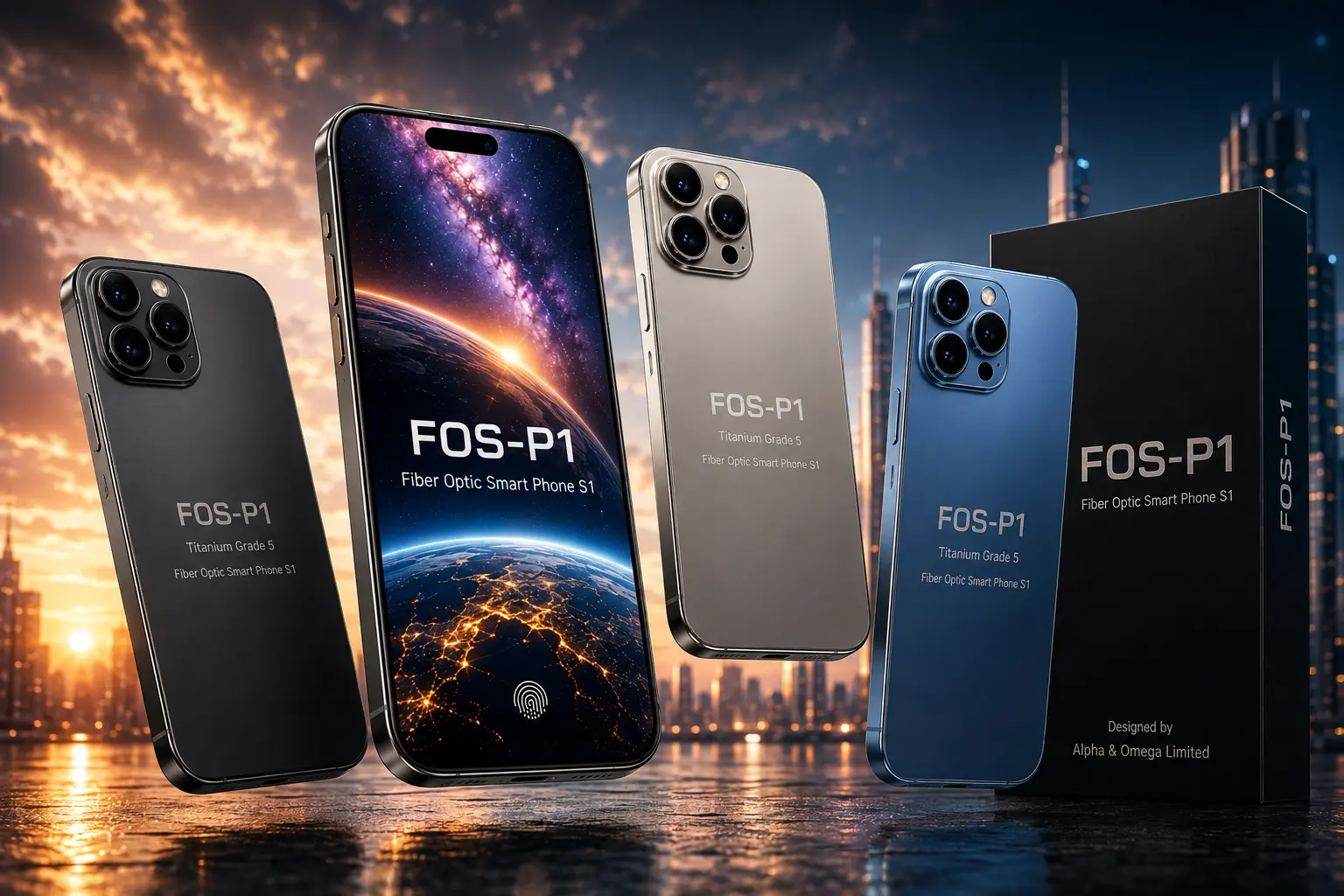
Experience the world’s first fiber‑optic smartphone — engineered with a titanium structural chassis, sapphire front optical layer, multimode fiber‑optic display core, RGB light‑injection system, AI‑accelerated processing platform, advanced thermal management, and a complete multi‑volume engineering blueprint architecture. Designed for premium performance, long service life, and next‑generation mobile innovation.
FOS‑P1 — Fiber‑Optic Smart Phone S1
Master Conceptual Blueprint Specification (MBP‑000)
Project Information
- Project Name: FOS‑P1
- System Name: Fiber‑Optic Smart Phone S1
- Document Number: MBP‑000
- Document Type: Master Conceptual Blueprint Specification
- Purpose: Parent engineering specification defining the conceptual architecture, subsystem organization, interfaces, design requirements, and blueprint hierarchy for the FOS‑P1 smartphone.
Project Objective
The FOS‑P1 project develops a premium smartphone concept that scales the FOS‑WDP‑S1 fiber‑optic display technology into a compact handheld form factor while maintaining a unified engineering architecture. The master document acts as the single reference from which all subsystem blueprint documents derive, following the same parent‑document philosophy as the FOS‑WDP‑S1 master blueprint.
Design Goals
- Form Factor: Compact flagship smartphone
- Display: Fiber‑optic display derived from FOS‑WDP‑S1 concept
- Chassis: Titanium structural chassis
- Internal Frame: Carbon‑composite internal frame
- Front Protection: High‑strength front protective optical layer
- Touch Interface: Capacitive multi‑touch
- Connectivity: Global cellular capability (design objective), Wi‑Fi, Bluetooth, NFC, GNSS
- Ports: USB‑C with S‑Port implementation
- Charging: Wireless and reverse wireless charging
- Imaging: Multi‑camera imaging system
- Processing: AI‑capable processing platform
- Power: High‑density battery
- Thermal: Passive/active thermal management
- Architecture: Modular internal architecture
- Lifecycle: Long service life
- Serviceability: Serviceable component layout
Master System Architecture
- Front Optical Assembly
- Capacitive Touch Layer
- Fiber‑Optic Display Core
- Optical Light Injection System
- Structural Midframe
- Main Logic Board
- Battery Module
- Camera Assembly
- Thermal Assembly
- Rear Housing
Primary Subsystems
- MBP‑001 Mechanical & Structural Architecture
- MBP‑002 Front Optical Assembly
- MBP‑003 Capacitive Touch Subsystem
- MBP‑004 Fiber‑Optic Display Core
- MBP‑005 Light Injection System
- MBP‑006 Titanium Chassis Assembly
- MBP‑007 Motherboard & Processing System
- MBP‑008 Battery & Power Management
- MBP‑009 Camera System
- MBP‑010 RF & Antenna System
- MBP‑011 SIM/eSIM & Storage
- MBP‑012 USB‑C / S‑Port
- MBP‑013 Audio System
- MBP‑014 Sensors & Biometrics
- MBP‑015 Thermal Management
- MBP‑016 Software Architecture
- MBP‑017 Manufacturing & Assembly
- MBP‑018 Diagnostics & Testing
- MBP‑019 Safety & Protection
- MBP‑020 System Integration
- MBP‑021 Wiring & Flex Architecture
- MBP‑022 Fasteners & Adhesives
- MBP‑023 Buttons & Haptics
- MBP‑024 Environmental Sealing
- MBP‑025 Surface Finishes
- MBP‑026 Regulatory Design Requirements
- MBP‑027 Service & Repair
- MBP‑028 Quality Assurance
- MBP‑029 Bill of Materials
- MBP‑030 Engineering Revision Control
Display Architecture (Concept)
The display architecture is derived from the layered structure used in the FOS‑WDP‑S1 wall‑panel system, adapted to a smartphone‑scale assembly. It combines a protective optical cover, capacitive touch layer, fiber‑optic display core, optical coupling layer, RGB light‑injection system, and display driver electronics, all supported by a midframe and integrated with thermal and rear electronics enclosures.
- Protective optical cover
- Capacitive touch layer
- Fiber‑optic display core
- Optical coupling layer
- RGB light‑injection system
- Display driver electronics
- Midframe support
- Thermal interface
- Rear electronics enclosure
Electronic Architecture
- Main application processor
- AI acceleration engine
- Graphics processor
- System memory
- Non‑volatile storage
- Display controller
- Power management ICs
- Camera processors
- Wireless communications modules
- Audio subsystem
- Sensor hub
- Security processor
Communication Systems
- 5G/LTE (design target)
- Wi‑Fi
- Bluetooth
- NFC
- GNSS
- USB‑C
- S‑Port
- eSIM and Nano‑SIM support
Camera System
- Multi‑camera rear array
- Front camera
- Optical image stabilization (design objective)
- HDR imaging
- AI‑assisted image processing
- Video recording subsystem
Power System
- Rechargeable battery pack
- Power management circuitry
- USB‑C charging
- Wireless charging
- Reverse wireless charging
- Battery protection
- Thermal monitoring
Thermal Management
- Heat spreader
- Vapor chamber or equivalent cooling solution
- Thermal interface materials
- Temperature sensors
- Dynamic performance management
Audio System
- Stereo speakers
- Multi‑microphone array
- Noise suppression
- Audio DSP
- Digital audio interfaces
Sensor System
- Ambient light
- Proximity
- Accelerometer
- Gyroscope
- Magnetometer
- Barometer (optional)
- Fingerprint sensor
- Face authentication hardware
Software Architecture
- Bootloader
- Operating system
- Hardware abstraction layer
- Device drivers
- Security services
- AI framework
- User applications
- Diagnostics
- Firmware update system
Manufacturing Philosophy
- Manufacture chassis
- Produce optical display assembly
- Integrate touch subsystem
- Assemble display module
- Install motherboard
- Install cameras
- Install battery
- Install RF assemblies
- Integrate thermal system
- Final enclosure assembly
- Firmware installation
- Calibration
- Functional testing
- Quality assurance
Engineering Principles
- Single‑source master specification
- Modular subsystem design
- Cross‑referenced interfaces
- Consistent component hierarchy
- Service‑oriented construction
- Revision‑controlled documentation
- Conceptual engineering realism
- Traceable subsystem requirements
Master Blueprint Hierarchy
MBP‑000 serves as the parent specification for all subsystem documents. Each subsystem inherits system‑level requirements, interfaces, materials, and design intent from this document, following the parent‑child organization established in the FOS‑WDP‑S1 master blueprint.
Document Control
- Project: FOS‑P1 – Fiber‑Optic Smart Phone S1
- Package: Master Blueprint Package (MBP)
- Parent Document: MBP‑000
- Revision: R1.0 Concept
FOS‑P1 Commercial Manufacturing License
The FOS‑P1 Fiber‑Optic Smart Phone S1 is licensed as a premium conceptual engineering system. This license grants manufacturers the right to produce, distribute, and sell real-world implementations of the FOS‑P1 architecture while ensuring full copyright protection, global royalty enforcement, and long-term conceptual IP ownership retained by the Licensor.
View Full License AgreementLicensing & Royalty Pricing Structure
| License Type | Commercial Manufacturing License |
| One‑Time License Fee | USD $5,000,000 |
| Royalty Rate | 8% per unit sold worldwide |
| Term | 5 Years (Mandatory Renewal) |
| Ownership | Licensor retains 100% copyright & IP |
| Patents | All patents & derivative patents prohibited |
| Sublicensing | Strictly prohibited |
| Reporting & Audits | Quarterly reporting & mandatory audit compliance |
Commercial Manufacturing License Agreement
This Commercial Manufacturing License Agreement (“Agreement”) governs the rights and obligations between the Licensor (Blueprints Market / Paul Geoffrey Smith) and the Licensee (the purchasing manufacturer). By purchasing the FOS‑P1 Conceptual Engineering Package, the Licensee agrees to the following legally binding terms:
1. Grant of License
The Licensor grants the Licensee a non‑exclusive, non‑transferable, non‑sublicensable right to manufacture, distribute, and sell physical products derived from the FOS‑P1 conceptual engineering system for a period of five (5) years, subject to mandatory renewal.
2. Intellectual Property Ownership
The Licensor retains full and exclusive ownership of all conceptual engineering designs, blueprints, documentation, system architecture, and derivative works. No transfer of ownership is granted under this Agreement.
3. Royalty Obligations
The Licensee agrees to pay a royalty of eight percent (8%) of the wholesale price for every unit manufactured, distributed, or sold worldwide that incorporates any portion of the FOS‑P1 conceptual engineering system, whether in whole or in part.
4. Reporting Requirements
The Licensee must submit quarterly sales reports detailing units manufactured, units sold, wholesale pricing, and total royalty amounts owed. Failure to report constitutes a breach of Agreement.
5. Audit Rights
The Licensor reserves the right to conduct independent audits of the Licensee’s manufacturing and sales records to verify compliance. The Licensee must provide full access to relevant documentation upon request.
6. Patent Restrictions
The Licensee is strictly prohibited from filing patents, patent applications, or derivative patents based on any portion of the FOS‑P1 conceptual engineering system. Any attempt to patent the system or its derivatives constitutes immediate termination of the Agreement.
7. Sublicensing Restrictions
The Licensee may not sublicense, transfer, lease, or otherwise distribute the conceptual engineering package or any portion thereof to third parties.
8. Global Enforcement
This Agreement is enforceable worldwide. Any unauthorized use, reproduction, or distribution of the conceptual engineering system will result in legal action, damages, and immediate termination of the License.
9. Renewal
Renewal of this Agreement is mandatory every five (5) years. Renewal fees and updated royalty terms may apply based on market conditions and technological advancements.
Why This Technology Matters
The FOS‑P1 represents a breakthrough in smartphone engineering. Its multimode fiber‑optic display core, titanium structural chassis, multi‑camera imaging system, advanced thermal architecture, secure software stack, and modular subsystem design make it a next‑generation platform for premium mobile devices. Manufacturers who adopt this system gain access to a world‑first conceptual architecture capable of generating multi‑billion‑dollar product lines.
How to License the FOS‑P1 System
To obtain the Commercial Manufacturing License, manufacturers must contact Blueprints Market directly. Licensing for the FOS‑P1 Fiber‑Optic Smart Phone S1 is handled on a case‑by‑case basis, including full verification, contractual review, and compliance assessment. Once approved, the Licensee receives the complete Master Blueprint Package (MBP‑000 → MBP‑030), commercial manufacturing rights, and access to ongoing conceptual engineering updates.