FOS‑P1 — Fiber‑Optic Smart Phone S1
Front Optical Assembly (MBP‑002 — R1.0)
Purpose & Scope
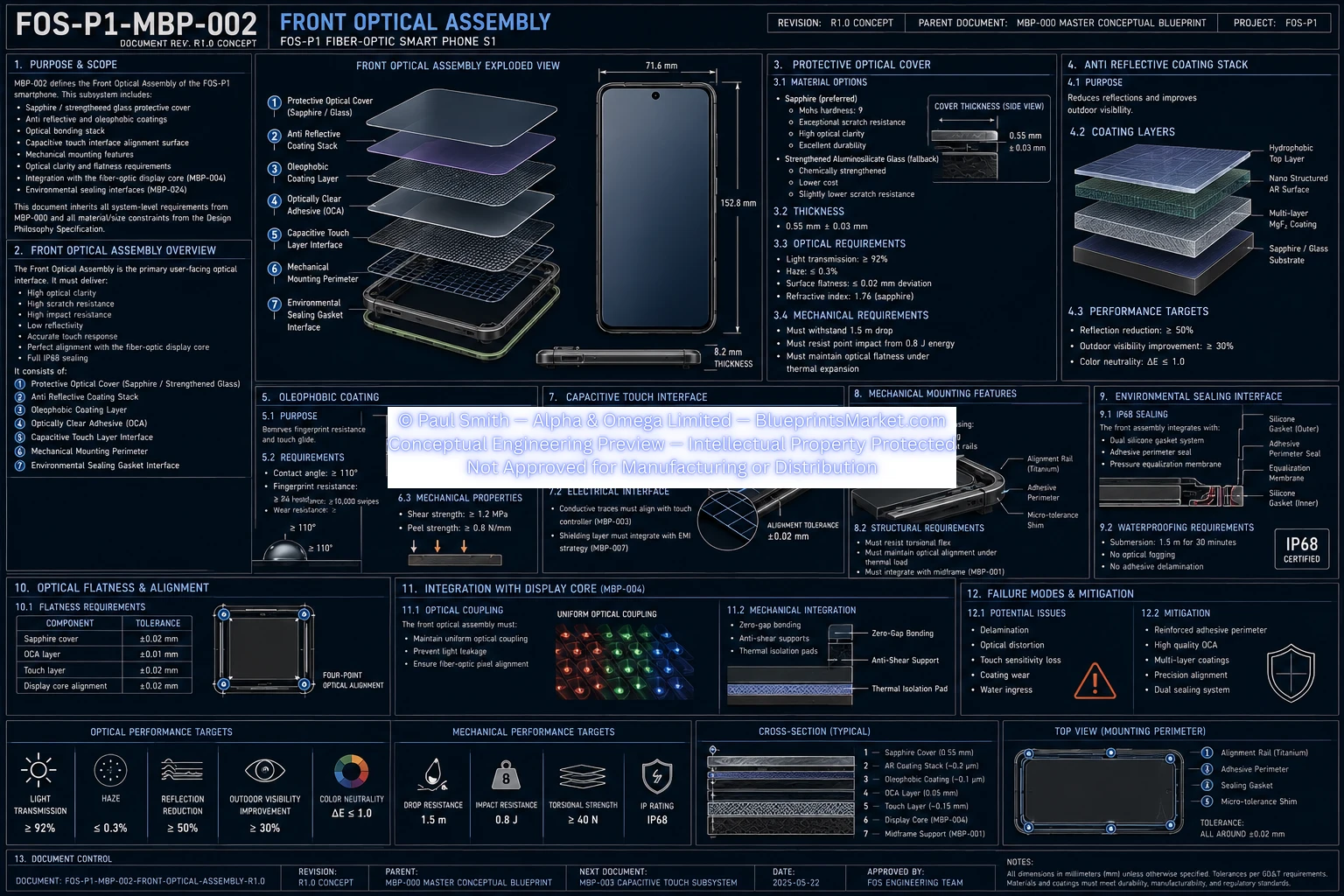
MBP‑002 defines the complete Front Optical Assembly of the FOS‑P1 smartphone. This subsystem includes the protective sapphire/strengthened glass cover, anti‑reflective and oleophobic coatings, optical bonding stack, capacitive touch interface alignment surface, mechanical mounting features, optical clarity requirements, and environmental sealing interfaces. It inherits all system‑level requirements from MBP‑000 and all material/size constraints from the Design Philosophy Specification.
Front Optical Assembly Overview
The Front Optical Assembly is the primary user‑facing optical interface. It must deliver high optical clarity, scratch resistance, impact resistance, low reflectivity, accurate touch response, perfect alignment with the fiber‑optic display core, and full IP68 sealing.
- Protective Optical Cover (Sapphire / Strengthened Glass)
- Anti‑Reflective Coating Stack
- Oleophobic Coating Layer
- Optically Clear Adhesive (OCA)
- Capacitive Touch Layer Interface
- Mechanical Mounting Perimeter
- Environmental Sealing Gasket Interface
Protective Optical Cover
Material Options
- Sapphire (preferred)
- Mohs hardness: 9
- Exceptional scratch resistance
- High optical clarity
- Excellent durability
- Strengthened Aluminosilicate Glass (fallback)
- Chemically strengthened
- Lower cost
- Slightly lower scratch resistance
Thickness
0.55 mm ± 0.03 mm
Optical Requirements
- Light transmission: ≥ 92%
- Haze: ≤ 0.3%
- Surface flatness: ≤ 0.02 mm deviation
- Refractive index (sapphire): 1.76
Mechanical Requirements
- Must withstand 1.5 m drop
- Must resist 0.8 J point impact
- Must maintain optical flatness under thermal expansion
Anti‑Reflective Coating Stack
Purpose
Reduces reflections and improves outdoor visibility.
Coating Layers
- Multi‑layer magnesium fluoride (MgF₂)
- Nano‑structured anti‑reflective surface
- Hydrophobic top layer
Performance Targets
- Reflection reduction: ≥ 50%
- Outdoor visibility improvement: ≥ 30%
- Color neutrality: ΔE ≤ 1.0
Oleophobic Coating
Purpose
Improves fingerprint resistance and touch glide.
Requirements
- Contact angle: ≥ 110°
- Fingerprint resistance: ≥ 24 hours continuous use
- Wear resistance: ≥ 10,000 swipes
Optically Clear Adhesive (OCA)
Purpose
Bonds the protective cover to the capacitive touch layer.
Requirements
- Thickness: 0.05 mm ± 0.01 mm
- Transparency: ≥ 99%
- Bubble‑free bonding
- UV stable
- No yellowing over 5 years
Mechanical Properties
- Shear strength: ≥ 1.2 MPa
- Peel strength: ≥ 0.8 N/mm
Capacitive Touch Interface
Alignment Requirements
- Touch layer must align within ±0.02 mm
- No air gaps permitted
- Uniform sensitivity across entire display
Electrical Interface
- Conductive traces must align with touch controller (MBP‑003)
- Shielding layer must integrate with EMI strategy (MBP‑007)
Mechanical Mounting Features
Perimeter Mounting
- Adhesive perimeter bonding
- Titanium chassis alignment rails
- Micro‑tolerance shims
Structural Requirements
- Must resist torsional flex
- Must maintain optical alignment under thermal load
- Must integrate with midframe (MBP‑001)
Environmental Sealing Interface
IP68 Sealing
- Dual silicone gasket system
- Adhesive perimeter seal
- Pressure equalization membrane
Waterproofing Requirements
- Submersion: 1.5 m for 30 minutes
- No optical fogging
- No adhesive delamination
Optical Flatness & Alignment
Flatness Requirements
| Component | Tolerance |
|---|---|
| Sapphire cover | ±0.02 mm |
| OCA layer | ±0.01 mm |
| Touch layer | ±0.02 mm |
| Display core alignment | ±0.02 mm |
Alignment Strategy
- Four‑point optical alignment
- Laser‑guided positioning
- Automated bonding process
Integration with Display Core (MBP‑004)
Optical Coupling
- Uniform optical coupling
- No light leakage
- Precise fiber‑optic pixel alignment
Mechanical Integration
- Zero‑gap bonding
- Anti‑shear supports
- Thermal isolation pads
Failure Modes & Mitigation
Potential Issues
- Delamination
- Optical distortion
- Touch sensitivity loss
- Coating wear
- Water ingress
Mitigation
- Reinforced adhesive perimeter
- High‑quality OCA
- Multi‑layer coatings
- Precision alignment
- Dual sealing system
Document Control
- Document: FOS‑P1‑MBP‑002‑FRONT‑OPTICAL‑ASSEMBLY‑R1.0
- Revision: R1.0 Concept
- Parent: MBP‑000
- Next Document: MBP‑003 — Capacitive Touch Subsystem
FOS‑P1 Commercial Manufacturing License
The FOS‑P1 Fiber‑Optic Smart Phone S1 is licensed as a premium conceptual engineering system. This license grants manufacturers the right to produce, distribute, and sell real-world implementations of the FOS‑P1 architecture while ensuring full copyright protection, global royalty enforcement, and long-term conceptual IP ownership retained by the Licensor.
View Full License AgreementLicensing & Royalty Pricing Structure
| License Type | Commercial Manufacturing License |
| One‑Time License Fee | USD $5,000,000 |
| Royalty Rate | 8% per unit sold worldwide |
| Term | 5 Years (Mandatory Renewal) |
| Ownership | Licensor retains 100% copyright & IP |
| Patents | All patents & derivative patents prohibited |
| Sublicensing | Strictly prohibited |
| Reporting & Audits | Quarterly reporting & mandatory audit compliance |
Commercial Manufacturing License Agreement
This Commercial Manufacturing License Agreement (“Agreement”) governs the rights and obligations between the Licensor (Blueprints Market / Paul Geoffrey Smith) and the Licensee (the purchasing manufacturer). By purchasing the FOS‑P1 Conceptual Engineering Package, the Licensee agrees to the following legally binding terms:
1. Grant of License
The Licensor grants the Licensee a non‑exclusive, non‑transferable, non‑sublicensable right to manufacture, distribute, and sell physical products derived from the FOS‑P1 conceptual engineering system for a period of five (5) years, subject to mandatory renewal.
2. Intellectual Property Ownership
The Licensor retains full and exclusive ownership of all conceptual engineering designs, blueprints, documentation, system architecture, and derivative works. No transfer of ownership is granted under this Agreement.
3. Royalty Obligations
The Licensee agrees to pay a royalty of eight percent (8%) of the wholesale price for every unit manufactured, distributed, or sold worldwide that incorporates any portion of the FOS‑P1 conceptual engineering system, whether in whole or in part.
4. Reporting Requirements
The Licensee must submit quarterly sales reports detailing units manufactured, units sold, wholesale pricing, and total royalty amounts owed. Failure to report constitutes a breach of Agreement.
5. Audit Rights
The Licensor reserves the right to conduct independent audits of the Licensee’s manufacturing and sales records to verify compliance. The Licensee must provide full access to relevant documentation upon request.
6. Patent Restrictions
The Licensee is strictly prohibited from filing patents, patent applications, or derivative patents based on any portion of the FOS‑P1 conceptual engineering system. Any attempt to patent the system or its derivatives constitutes immediate termination of the Agreement.
7. Sublicensing Restrictions
The Licensee may not sublicense, transfer, lease, or otherwise distribute the conceptual engineering package or any portion thereof to third parties.
8. Global Enforcement
This Agreement is enforceable worldwide. Any unauthorized use, reproduction, or distribution of the conceptual engineering system will result in legal action, damages, and immediate termination of the License.
9. Renewal
Renewal of this Agreement is mandatory every five (5) years. Renewal fees and updated royalty terms may apply based on market conditions and technological advancements.
Why This Technology Matters
The FOS‑P1 represents a breakthrough in smartphone engineering. Its multimode fiber‑optic display core, titanium structural chassis, multi‑camera imaging system, advanced thermal architecture, secure software stack, and modular subsystem design make it a next‑generation platform for premium mobile devices. Manufacturers who adopt this system gain access to a world‑first conceptual architecture capable of generating multi‑billion‑dollar product lines.
How to License the FOS‑P1 System
To obtain the Commercial Manufacturing License, manufacturers must contact Blueprints Market directly. Licensing for the FOS‑P1 Fiber‑Optic Smart Phone S1 is handled on a case‑by‑case basis, including full verification, contractual review, and compliance assessment. Once approved, the Licensee receives the complete Master Blueprint Package (MBP‑000 → MBP‑030), commercial manufacturing rights, and access to ongoing conceptual engineering updates.
Blueprint Image Set — FOS‑P1
High‑resolution engineering blueprint sheets for the complete fiber‑optic smartphone system.