FOS‑P1 — Fiber‑Optic Smart Phone S1
Bill of Materials (MBP‑029 — R1.0)
Purpose & Scope
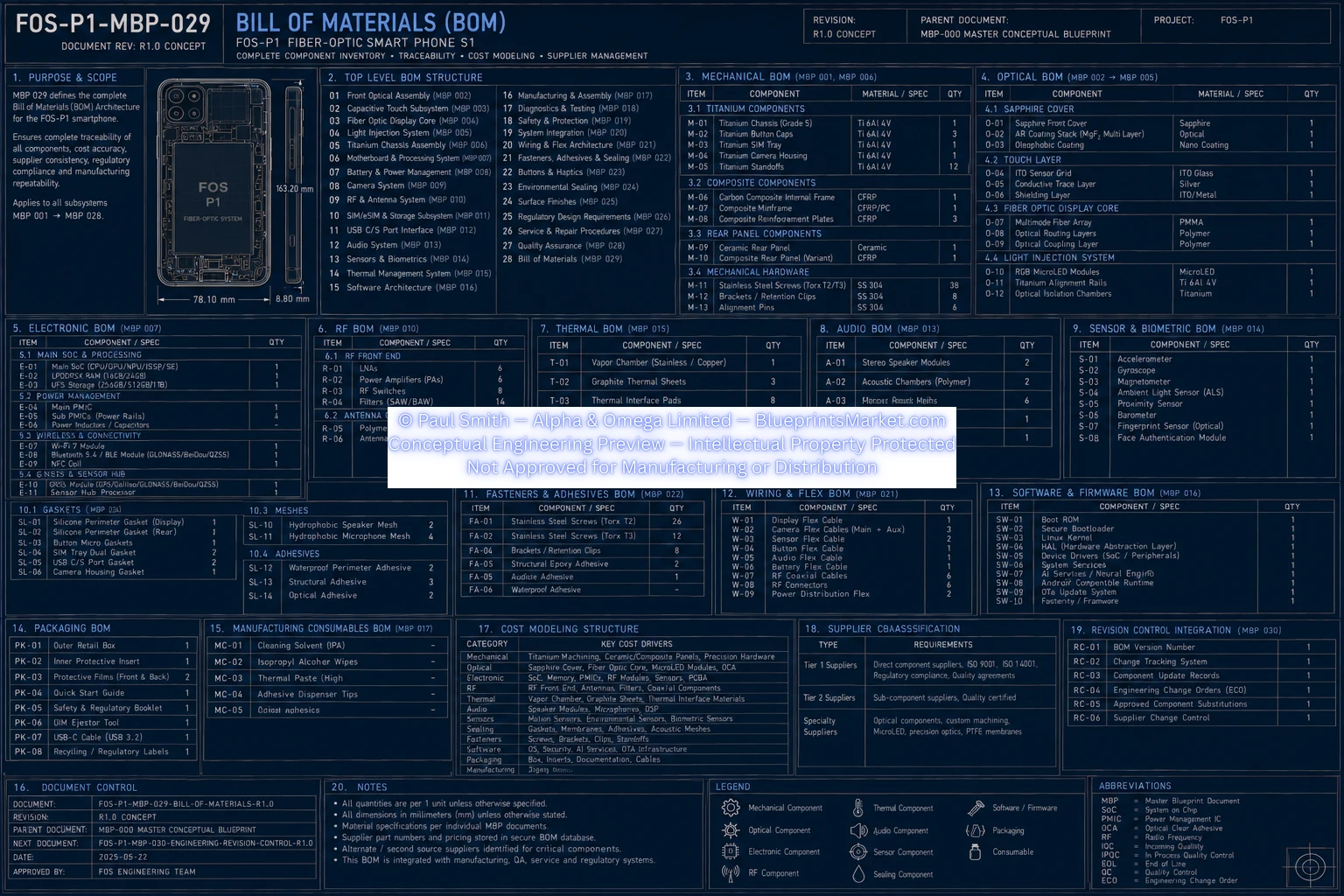
MBP‑029 defines the complete Bill of Materials (BOM) architecture for the FOS‑P1 smartphone. This includes the top‑level BOM structure, subsystem BOM breakdown (MBP001 → MBP028), component categories, material specifications, electronic/mechanical/optical/thermal/RF component listings, sealing materials, manufacturing consumables, cost modeling, supplier classification, and revision control integration.
BOM System Overview
The BOM system ensures complete traceability, accurate cost modeling, supplier consistency, manufacturing repeatability, regulatory compliance, QA integration, serviceability support, and revision control.
- Top‑Level BOM
- Mechanical BOM
- Optical BOM
- Electronic BOM
- RF BOM
- Thermal BOM
- Audio BOM
- Sensor BOM
- Sealing BOM
- Fasteners & Adhesives BOM
- Software & Firmware BOM
- Packaging BOM
- Manufacturing Consumables BOM
Top‑Level BOM Structure
Major Assemblies
- Front Optical Assembly (MBP002)
- Capacitive Touch Subsystem (MBP003)
- Fiber‑Optic Display Core (MBP004)
- Light Injection System (MBP005)
- Titanium Chassis Assembly (MBP006)
- Motherboard & Processing System (MBP007)
- Battery & Power Management (MBP008)
- Camera System (MBP009)
- RF & Antenna System (MBP010)
- SIM/eSIM & Storage Subsystem (MBP011)
- USB‑C/S‑Port Interface (MBP012)
- Audio System (MBP013)
- Sensors & Biometrics (MBP014)
- Thermal Management System (MBP015)
- Software Architecture (MBP016)
- Manufacturing & Assembly (MBP017)
- Diagnostics & Testing (MBP018)
- Safety & Protection (MBP019)
- System Integration (MBP020)
- Wiring & Flex Architecture (MBP021)
- Fasteners, Adhesives & Sealing (MBP022)
- Buttons & Haptics (MBP023)
- Environmental Sealing (MBP024)
- Surface Finishes (MBP025)
- Regulatory Design Requirements (MBP026)
- Service & Repair Procedures (MBP027)
- Quality Assurance (MBP028)
Mechanical BOM (MBP001, MBP006)
Titanium Components
- Titanium chassis (Grade 5)
- Titanium button caps
- Titanium SIM tray
- Titanium camera housing
- Titanium standoffs
Composite Components
- Carbon‑composite internal frame
- Composite midframe
- Composite reinforcement plates
Rear Panel Components
- Ceramic rear panel
- Composite rear panel (variant)
Mechanical Hardware
- Stainless steel screws (Torx T2/T3)
- Brackets
- Alignment pins
Optical BOM (MBP002 → MBP005)
Sapphire Cover
- Sapphire front cover
- AR coating stack
- Oleophobic coating
Touch Layer
- ITO sensor grid
- Conductive trace layer
- Shielding layer
Fiber‑Optic Display Core
- Multimode fibers
- Optical routing layers
- Optical coupling layer
Light Injection System
- RGB MicroLED modules
- Titanium alignment rails
- Optical isolation chambers
Electronic BOM (MBP007)
Main SoC
- CPU/GPU/NPU
- ISP
- DSP
- Security enclave
Memory
- LPDDR5X RAM
- UFS storage
PMICs
- Main PMIC
- Sub‑PMICs
Wireless Modules
- WiFi 7 module
- Bluetooth module
- NFC coil
GNSS Module
- GPS / Galileo / GLONASS / BeiDou / QZSS
Sensor Hub
- Low‑power sensor processor
RF BOM (MBP010)
RF Front‑End
- LNAs
- PAs
- RF switches
- Filters
Antenna Components
- Polymer antenna windows
- Antenna feed lines
- Coaxial connectors
Thermal BOM (MBP015)
Thermal Components
- Vapor chamber
- Graphite sheets
- Thermal pads
- Titanium conduction rails
Audio BOM (MBP013)
Speakers
- Stereo speaker modules
- Acoustic chambers
Microphones
- Multi‑microphone array
- Acoustic meshes
DSP
- Audio DSP
Sensor & Biometric BOM (MBP014)
Motion Sensors
- Accelerometer
- Gyroscope
- Magnetometer
Environmental Sensors
- ALS
- Proximity
- Barometer
Biometrics
- Fingerprint sensor
- Face authentication hardware
Sealing BOM (MBP024)
Gaskets
- Silicone gaskets
- Micro‑gaskets
Membranes
- PTFE pressure equalization membranes
Meshes
- Hydrophobic acoustic meshes
Adhesives
- Waterproof perimeter adhesive
- Structural adhesive
- Optical adhesive (OCA)
Fasteners & Adhesives BOM (MBP022)
Fasteners
- Stainless steel screws
- Brackets
- Retention clips
Adhesives
- Structural epoxy
- UV‑curable adhesive
- Waterproof adhesive
Wiring & Flex BOM (MBP021)
Flex Cables
- Display flex
- Camera flex
- Sensor flex
- Button flex
- Audio flex
RF Lines
- Coaxial cables
- RF connectors
Power Lines
- Battery power lines
- PMIC distribution lines
Software & Firmware BOM (MBP016)
Software Components
- Boot ROM
- Secure bootloader
- Linux kernel
- HAL
- Drivers
- System services
- AI services
- Android‑compatible runtime
- OTA update system
Packaging BOM
Packaging Materials
- Box
- Inserts
- Documentation
- Protective films
Regulatory Requirements
- Recycling marks
- Material declarations
Manufacturing Consumables BOM (MBP017)
Consumables
- Adhesives
- Cleaning solvents
- Thermal paste
- Alignment jigs
- ESD materials
Cost Modeling Structure
Cost Categories
- Mechanical
- Optical
- Electronic
- RF
- Thermal
- Audio
- Sensors
- Sealing
- Fasteners
- Software
- Packaging
- Manufacturing consumables
Cost Drivers
- Titanium machining
- Sapphire cover
- Fiber‑optic display core
- RGB light injection system
- SoC and memory
- Camera modules
Supplier Classification
Supplier Types
- Tier‑1 suppliers
- Tier‑2 suppliers
- Specialty suppliers
Requirements
- ISO 9001
- ISO 14001
- Regulatory compliance
Revision Control Integration (MBP030)
BOM Revisioning
- BOM version numbers
- Change tracking
- Component updates
Engineering Change Orders (ECOs)
- BOM updates
- Supplier changes
- Component substitutions
Document Control
- Document: FOS‑P1‑MBP‑029‑BILL‑OF‑MATERIALS‑R1.0
- Revision: R1.0 Concept
- Parent: MBP‑000
- Next Document: MBP‑030 — Engineering Revision Control
FOS‑P1 Commercial Manufacturing License
The FOS‑P1 Fiber‑Optic Smart Phone S1 is licensed as a premium conceptual engineering system. This license grants manufacturers the right to produce, distribute, and sell real-world implementations of the FOS‑P1 architecture while ensuring full copyright protection, global royalty enforcement, and long-term conceptual IP ownership retained by the Licensor.
View Full License AgreementLicensing & Royalty Pricing Structure
| License Type | Commercial Manufacturing License |
| One‑Time License Fee | USD $5,000,000 |
| Royalty Rate | 8% per unit sold worldwide |
| Term | 5 Years (Mandatory Renewal) |
| Ownership | Licensor retains 100% copyright & IP |
| Patents | All patents & derivative patents prohibited |
| Sublicensing | Strictly prohibited |
| Reporting & Audits | Quarterly reporting & mandatory audit compliance |
Commercial Manufacturing License Agreement
This Commercial Manufacturing License Agreement (“Agreement”) governs the rights and obligations between the Licensor (Blueprints Market / Paul Geoffrey Smith) and the Licensee (the purchasing manufacturer). By purchasing the FOS‑P1 Conceptual Engineering Package, the Licensee agrees to the following legally binding terms:
1. Grant of License
The Licensor grants the Licensee a non‑exclusive, non‑transferable, non‑sublicensable right to manufacture, distribute, and sell physical products derived from the FOS‑P1 conceptual engineering system for a period of five (5) years, subject to mandatory renewal.
2. Intellectual Property Ownership
The Licensor retains full and exclusive ownership of all conceptual engineering designs, blueprints, documentation, system architecture, and derivative works. No transfer of ownership is granted under this Agreement.
3. Royalty Obligations
The Licensee agrees to pay a royalty of eight percent (8%) of the wholesale price for every unit manufactured, distributed, or sold worldwide that incorporates any portion of the FOS‑P1 conceptual engineering system, whether in whole or in part.
4. Reporting Requirements
The Licensee must submit quarterly sales reports detailing units manufactured, units sold, wholesale pricing, and total royalty amounts owed. Failure to report constitutes a breach of Agreement.
5. Audit Rights
The Licensor reserves the right to conduct independent audits of the Licensee’s manufacturing and sales records to verify compliance. The Licensee must provide full access to relevant documentation upon request.
6. Patent Restrictions
The Licensee is strictly prohibited from filing patents, patent applications, or derivative patents based on any portion of the FOS‑P1 conceptual engineering system. Any attempt to patent the system or its derivatives constitutes immediate termination of the Agreement.
7. Sublicensing Restrictions
The Licensee may not sublicense, transfer, lease, or otherwise distribute the conceptual engineering package or any portion thereof to third parties.
8. Global Enforcement
This Agreement is enforceable worldwide. Any unauthorized use, reproduction, or distribution of the conceptual engineering system will result in legal action, damages, and immediate termination of the License.
9. Renewal
Renewal of this Agreement is mandatory every five (5) years. Renewal fees and updated royalty terms may apply based on market conditions and technological advancements.
Why This Technology Matters
The FOS‑P1 represents a breakthrough in smartphone engineering. Its multimode fiber‑optic display core, titanium structural chassis, multi‑camera imaging system, advanced thermal architecture, secure software stack, and modular subsystem design make it a next‑generation platform for premium mobile devices. Manufacturers who adopt this system gain access to a world‑first conceptual architecture capable of generating multi‑billion‑dollar product lines.
How to License the FOS‑P1 System
To obtain the Commercial Manufacturing License, manufacturers must contact Blueprints Market directly. Licensing for the FOS‑P1 Fiber‑Optic Smart Phone S1 is handled on a case‑by‑case basis, including full verification, contractual review, and compliance assessment. Once approved, the Licensee receives the complete Master Blueprint Package (MBP‑000 → MBP‑030), commercial manufacturing rights, and access to ongoing conceptual engineering updates.
Blueprint Image Set — FOS‑P1
High‑resolution engineering blueprint sheets for the complete fiber‑optic smartphone system.