FOS‑WDP‑S1 — Hardware Abstraction Layer (HAL) Architecture
MBP‑019 — Master Blueprint Package
Fiber‑Optic Smart Wall Display Panel
Master Specifications
| Parameter | Specification |
|---|---|
| System Name | FOS‑WDP‑S1 |
| Type | Rigid, One‑Sided Smart Architectural Display |
| Dimensions | 2000 mm × 700 mm × 38 mm |
| Weight (Est.) | 28 kg |
| Mounting | Wall System |
| Power Input | 200–240V AC |
| Power Consumption | ≤ 350W (Max) |
| Operating Temperature | 0°C – 45°C |
| Storage Temperature | −10°C – 60°C |
| Certifications | CE, RoHS, RCM |
HAL Overview
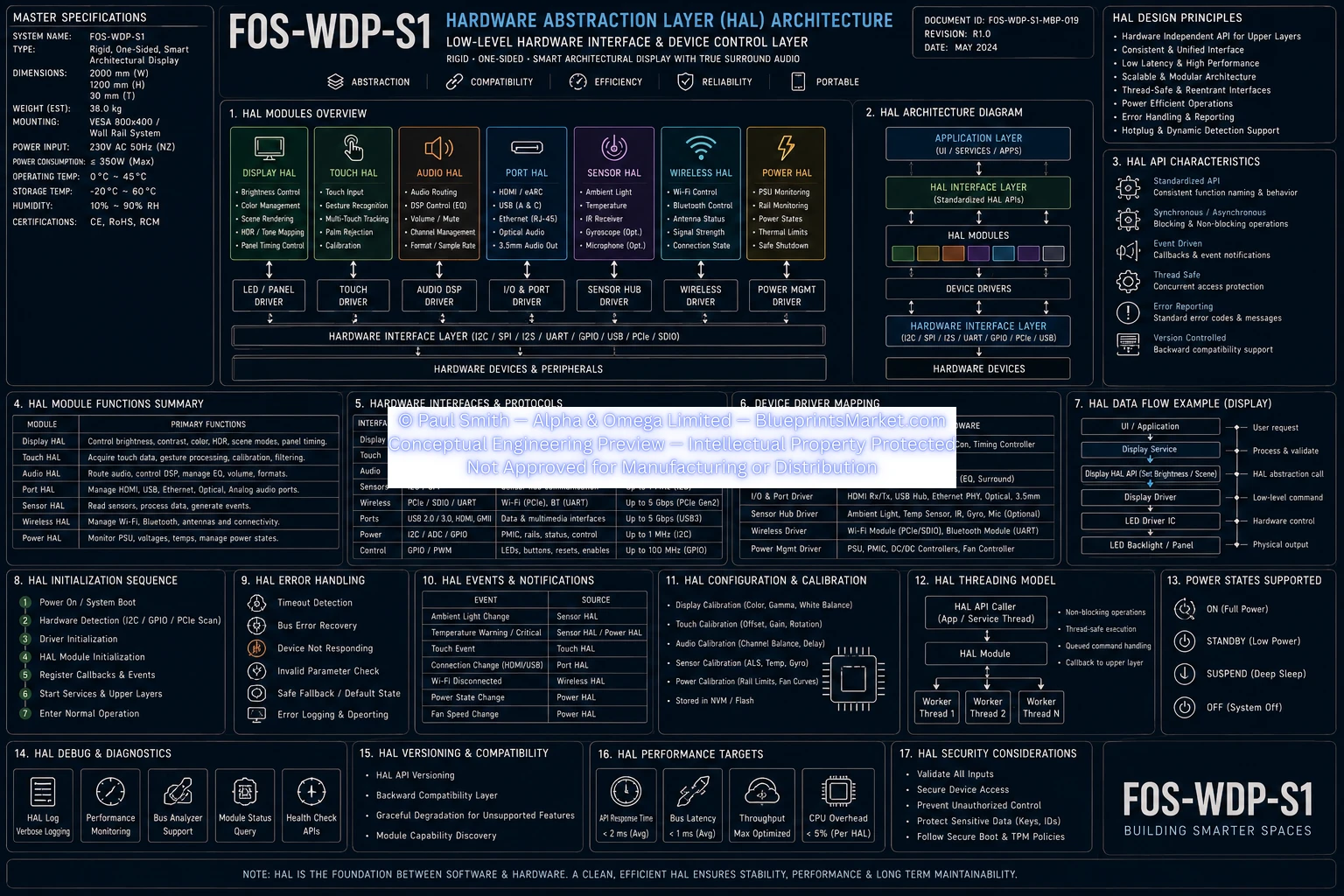
The Hardware Abstraction Layer (HAL) is the low‑level hardware interface and device control layer for the FOS‑WDP‑S1 system. It provides unified APIs, low‑latency access, modular scalability, thread‑safe operation, and dynamic hardware support. HAL is the foundation between software and hardware, ensuring stability, performance, and long‑term maintainability.
- Hardware‑independent APIs
- Unified device control
- Low‑latency hardware access
- Scalable modular architecture
- Thread‑safe operation
- Error filtering and reporting
- Hotplug and dynamic component support
HAL Modules Overview
Display HAL
- Brightness management
- Color control
- HDR
- Scene modes
- Panel timing
Touch HAL
- Touch input recognition
- Gesture mapping
- Pressure detection
- Calibration
Audio HAL
- Audio routing
- Format/codec management
- DSP processing
- Equalization
Port HAL
- USB
- Ethernet
- Optical
- Analog audio ports
Sensor HAL
- Ambient light
- Temperature
- Proximity
- Microphone (optional)
Wireless HAL
- Wi‑Fi
- Bluetooth
- Zigbee
- Cellular
Power HAL
- PSU monitoring
- Fan speed control
- Thermal shutdown
- Safe fallback
HAL Architecture Stack
- Application Layer (UI / Services / APIs)
- HAL Interface Layer (Standardized HAL APIs)
- HAL Modules
- Device Drivers
- Hardware Interface Layer (I²C / SPI / I²S / UART / GPIO / PCIe / USB)
- Hardware Devices
HAL Design Principles
- Hardware‑independent API for upper layers
- Consistent & unified interface
- Low latency & high efficiency
- Scalable & modular architecture
- Thread‑safe & reentrant interfaces
- Error filtering & reporting
- Hotplug & dynamic component support
HAL Module Function Summary
- Display HAL: Brightness, contrast, color, HDR, scene modes, panel timing
- Touch HAL: Gesture processing, calibration, filtering
- Audio HAL: Routing, codec management, DSP, EQ
- Port HAL: USB, Ethernet, optical, analog ports
- Sensor HAL: Ambient, temperature, proximity, microphone
- Wireless HAL: Wi‑Fi, Bluetooth, Zigbee, cellular
- Power HAL: PSU monitoring, voltages, power states
Hardware Interfaces & Protocols
| Interface | Protocol / Bus | Usage | Max Speed |
|---|---|---|---|
| Display | MIPI‑DSI / LVDS / GPIO | Panel control, backlight, timing | Up to 10 Gbps |
| Touch | I²C / SPI | Touch data acquisition | Up to 3 Mbps |
| Audio | I²S / SPDIF / PCM | Audio routing | Up to 12 Mbps |
| Port | USB / SDIO / UART | External connectivity | Up to 5 Gbps |
| Sensor | I²C / GPIO / UART | Sensor data acquisition | Up to 3 Mbps |
| Wireless | PCIe / SDIO / UART | Wireless communication | Up to 5 Gbps |
| Power | GPIO / PWM | PSU control, fan speed | Up to 1 MHz |
Device Driver Mapping
| Driver | Connected Hardware |
|---|---|
| LED / Panel Driver | LED backlight driver, panel TCon, timing controller |
| Touch Driver | Capacitive touch controller |
| Audio DSP Driver | Audio codec, DSP, amplifier |
| I/O & Port Driver | HDMI, RJ45, USB, Ethernet PHY, optical, 3.5 mm |
| Sensor Hub Driver | Ambient light, temperature, proximity, microphone |
| Wireless Driver | Wi‑Fi, Bluetooth, Zigbee, cellular modules |
| Power Management Driver | PSU, PMIC, DC/DC controllers, fan |
HAL Data Flow Example (Display)
- UI Application
- → User Request
- → HAL API
- → Display HAL
- → Display Driver
- → LED Backlight / Panel
HAL Initialization Sequence
- Power On / System Boot
- Hardware Detection (I²C / GPIO / PCIe Scan)
- Driver Initialization
- Register Callbacks & Events
- Start Services & Upper Layers
- Enter Normal Operation
HAL Error Handling
- Timeout detection
- Error recovery
- Device not responding
- Invalid parameter check
- Safe fallback / default state
- Error logging & reporting
HAL Events & Notifications
- Ambient light change
- Temperature change
- Audio format change
- Wi‑Fi disconnected
- PSU power state change
- Fan speed change
HAL Configuration & Calibration
- Display calibration (color, gamma, white balance)
- Touch calibration (pressure, sensitivity)
- Audio calibration (EQ, gain, balance)
- Sensor calibration (ambient, temp, proximity)
- Power calibration (fan curves)
- Stored in NVM / Flash
HAL Threading Model
- HAL API Caller (App / Service Thread)
- → HAL Module
- → Worker Thread 1
- → Worker Thread 2
- → Worker Thread N
Power States Supported
- ON (Full Power)
- STANDBY (Low Power)
- SUSPEND (Deep Sleep)
- OFF (System Off)
HAL Debug & Diagnostics
- HAL log / verbose logging
- Performance monitoring
- Bus analyzer support
- Health check APIs
HAL Versioning & Compatibility
- HAL API versioning
- Backward compatibility
- Graceful degradation for unsupported features
- Module capability discovery
HAL Performance Targets
| Metric | Target |
|---|---|
| Bus Latency | < 2 ms average |
| Bus Efficiency | Maximum optimized |
| CPU Overhead | < 6% per HAL module |
HAL Security Considerations
- Secure initialization of all inputs
- Secure API access control
- Validate device IDs
- Follow secure boot & TPM policies
Document Information
| Field | Value |
|---|---|
| Document ID | FOSWDPS1MBP019 |
| Revision | R1.0 |
| Title | Hardware Abstraction Layer Architecture |
| Tagline | Building Smarter Spaces |
Blueprint Access & Licensing
MBP‑019 — Hardware Abstraction Layer Architecture is part of the complete multi‑volume engineering blueprint package for the FOS‑WDP‑S1 Fiber‑Optic Smart Wall Display Panel.
Contact Blueprints Market for licensing, integration support or enterprise‑level deployment.