© Paul Smith — Alpha & Omega Limited — PlatformClouds.com — Conceptual Engineering Preview — Not Approved for Manufacturing
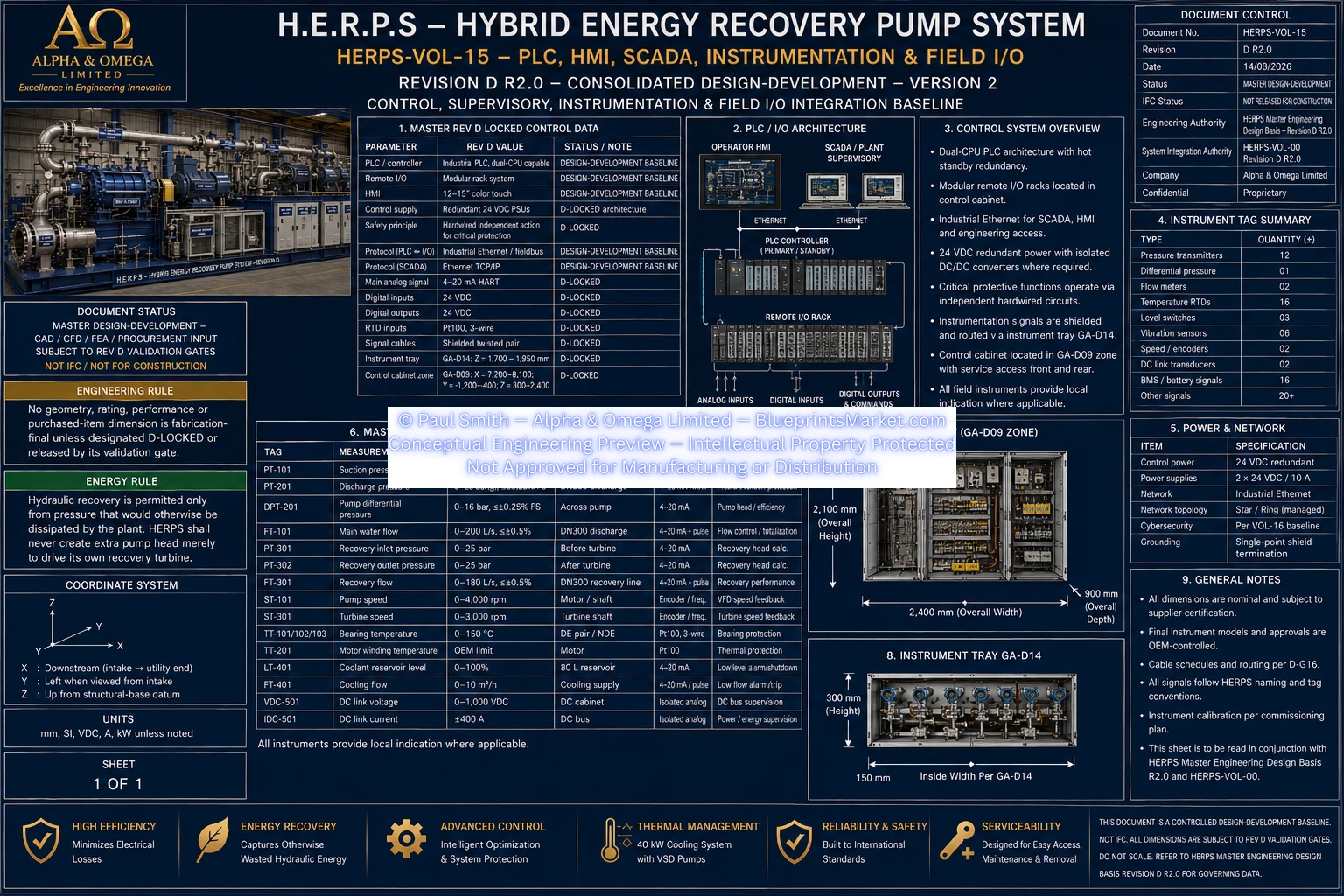
HERPS-VOL-15-PLC-HMI-SCADA-INSTRUMENTATION-AND-FIELD-IO-REV-D-R2.0.webp

Revision D R2.0 — Integrated Controls, Monitoring, Optimization & Validation Architecture
Hybrid Energy Recovery Pump System (H.E.R.P.S)
The H.E.R.P.S Revision D R2.0 platform integrates industrial PLC control, local HMI supervision, SCADA connectivity, process instrumentation, condition monitoring, event logging, engineering validation and constrained whole-machine performance optimization into the complete Hybrid Energy Recovery Pump System.
Revision D replaces the earlier stand-alone diagnostics concept with a coordinated control and monitoring architecture distributed across the system's control, safety, validation, acceptance and maintenance volumes. Diagnostics are therefore tied directly to the actual pump, motor, hydraulic recovery system, cooling system, electrical architecture, energy storage and safety functions.
| System Parameter | Revision D R2.0 Baseline |
|---|---|
| System | H.E.R.P.S — Hybrid Energy Recovery Pump System |
| Machine Architecture | Horizontal three-stage variable-speed centrifugal industrial water pump with controlled hydraulic-energy-recovery path |
| Rated Process Duty | 150 L/s — 540 m³/h |
| Rated TDH | 80 m water |
| Rated Pump Speed | 2,900 rpm |
| Controlled Pump-Speed Envelope | 1,500–3,600 rpm, subject to validated exclusion bands |
| Main Drive | 160 kW liquid-cooled SynRM development baseline |
| Hydraulic Recovery Principle | Recovery only from genuinely available otherwise-wasted pressure reduction |
| Control Principle | Local deterministic operation with independent protective layers |
| Engineering Status | Revision D R2.0 Master Design Development — subject to validation gates |
The Revision D control system coordinates normal machine sequencing, permissives, operating modes, hydraulic control, cooling, energy-recovery operation and supervisory energy-system functions.
Local automatic operation remains available if the external SCADA or enterprise network becomes unavailable. Loss of external supervisory communications does not disable the local PLC, independent trips, VFD hardware protection, BMS protection or mechanical safeguards.
The local HMI provides an integrated operational view of the complete HERPS package rather than a stand-alone pump display.
Revision D makes system diagnostics measurable through coordinated instrumentation and trend data rather than relying on unsupported calculated performance claims.
Revision D incorporates timestamped alarm, event, operator-action, configuration-change and trip logging so abnormal events can be traced to their initiating condition.
HERPS Revision D supports controlled supervisory integration through industrial communication interfaces while retaining independent local machine operation.
Remote write access is disabled by default. Any remote command capability requires authenticated role-based project approval and does not form a dependency for local safe operation.
Revision D upgrades HERPS from component-centric control to constrained whole-machine optimization. The objective is to operate the complete hydraulic, drive, recovery, thermal and energy system efficiently while remaining inside validated pressure, flow, cavitation, thermal, electrical and safety limits.
Optimization is subordinate to process and safety constraints. The optimization layer cannot override pressure limits, required flow, cavitation limits, thermal limits, equipment limits or independent protective functions.
The Revision D energy-recovery architecture uses a controlled parallel hydraulic path. Pump flow is distributed between the direct and recovery paths while maintaining the fundamental relationship:
Qpump = Qdirect + Qrecovery
The recovery controller may capture energy only where a genuine otherwise-wasted pressure reduction exists. No control or optimization mode is permitted to deliberately increase pump head merely to create additional turbine output.
| Mode | Purpose |
|---|---|
| Manual Commissioning | Controlled setup, testing and commissioning activity |
| Automatic Flow Control | Maintains required process flow within validated machine limits |
| Automatic Pressure Control | Maintains controlled hydraulic pressure without violating system constraints |
| Energy Recovery | Uses the parallel recovery path where genuine recoverable head is available |
| Minimum-Specific-Energy Optimization | Coordinates the complete machine toward lower energy use within process and safety constraints |
| Peak Shaving | Coordinates available energy storage with permitted operating demand |
| Ride-Through | Supports controlled system continuity according to released power-system logic |
| Standby | Maintains the package in a prepared non-running state |
| Emergency Shutdown | Independent protective action overrides normal optimization and operating commands |
Revision D uses measured operating history as the foundation for condition-based maintenance. Accepted FAT/SAT and as-left data provide reference baselines against which future machine condition can be trended.
The Revision D OT architecture is designed so that normal machine operation and independent protective functions do not depend upon enterprise or cloud connectivity.
Advanced diagnostics and optimization remain separate from independent protective functions. Revision D does not rely solely on normal PLC application logic, SCADA, cloud connectivity or operator response for safety-critical protection where an independent safeguard is required.
Revision D performance optimization is not declared successful from simulation targets or design intent alone. Engineering values that depend on CFD, prototype testing, rotordynamics, electrical studies, certified vendor information, functional-safety assessment or site conditions remain controlled until supporting evidence exists.
Revision D uses evidence-based acceptance. A target value, calculated value, simulation result or CAD dimension is not automatically considered a successful operating result.
The Revision D architecture supports long-term traceability of both operating condition and machine configuration.
Revision D supports future development through controlled interfaces, modular supervisory integration, industrial networking and formal engineering change control rather than through undefined add-on equipment.
Future control, monitoring, analytics or optimization capabilities can be evaluated against the frozen Revision D interfaces without silently altering hydraulic duty, machine geometry, safety functions, electrical protection, validated operating envelopes or other controlled system requirements.
This page describes the public-facing Revision D R2.0 design-development architecture. It does not claim unresolved validation-controlled or site-controlled information as final.
Final PLC/HMI vendor models, final network addressing, final firewall rules, final protection settings, final trip delays, final safety-integrity classification, certified BESS configuration, final site interfaces and measured performance results remain subject to their applicable engineering, supplier, validation and acceptance processes.
Revision D does not invent performance results. Final machine performance is established through traceable engineering validation, FAT, SAT, commissioning and the approved measured as-built record.
Advanced diagnostics and performance optimization are integrated across the complete H.E.R.P.S Revision D control, instrumentation, functional safety, validation, commissioning and maintenance architecture.
View the Complete HERPS System
Contact Blueprints Market for product, licensing and engineering-package enquiries.
HERPS-VOL-15-PLC-HMI-SCADA-INSTRUMENTATION-AND-FIELD-IO-REV-D-R2.0.webp
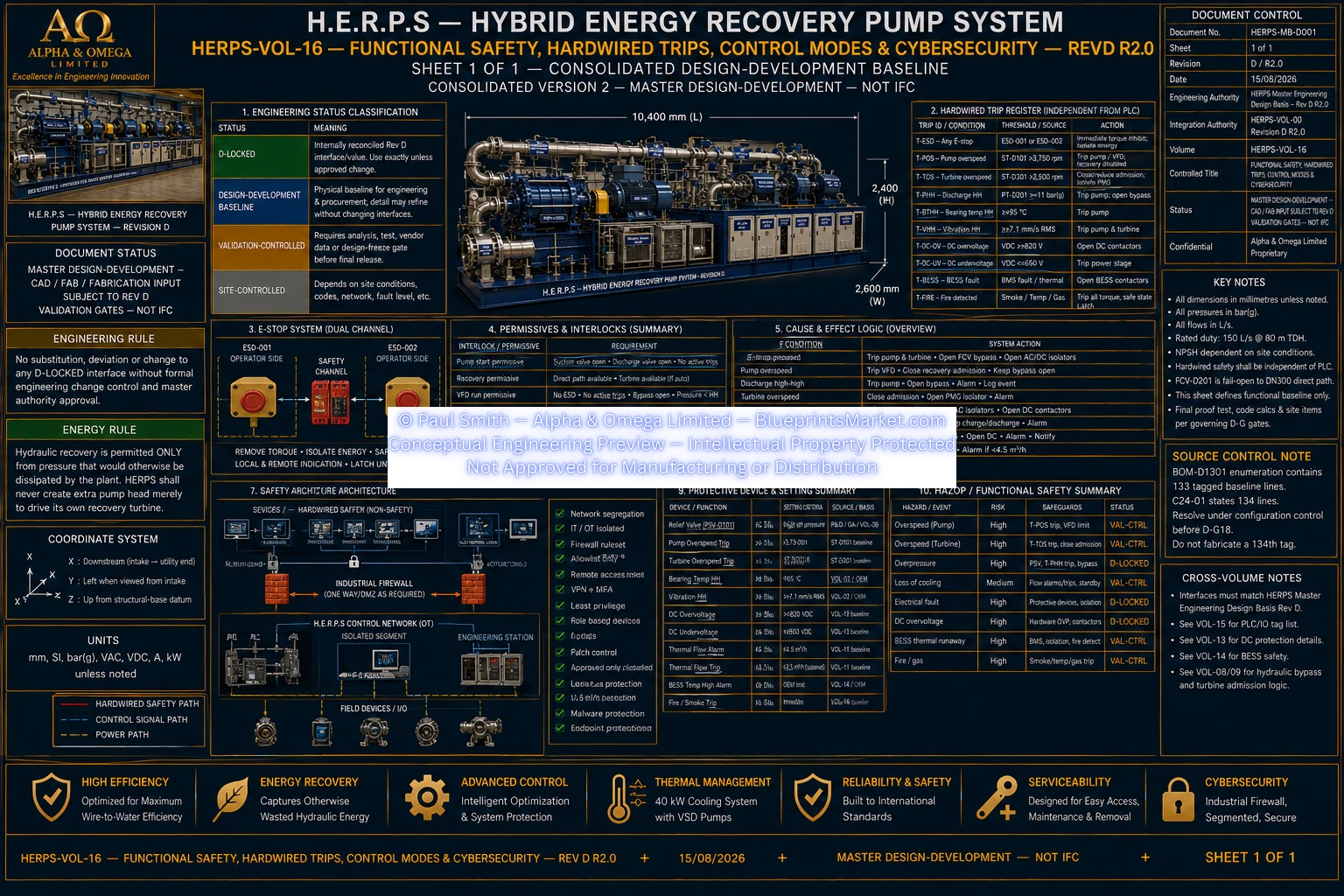
HERPS-VOL-16-FUNCTIONAL-SAFETY-HARDWIRED-TRIPS-CONTROL-MODES-AND-CYBERSECURITY-REV-D-R2.0.webp
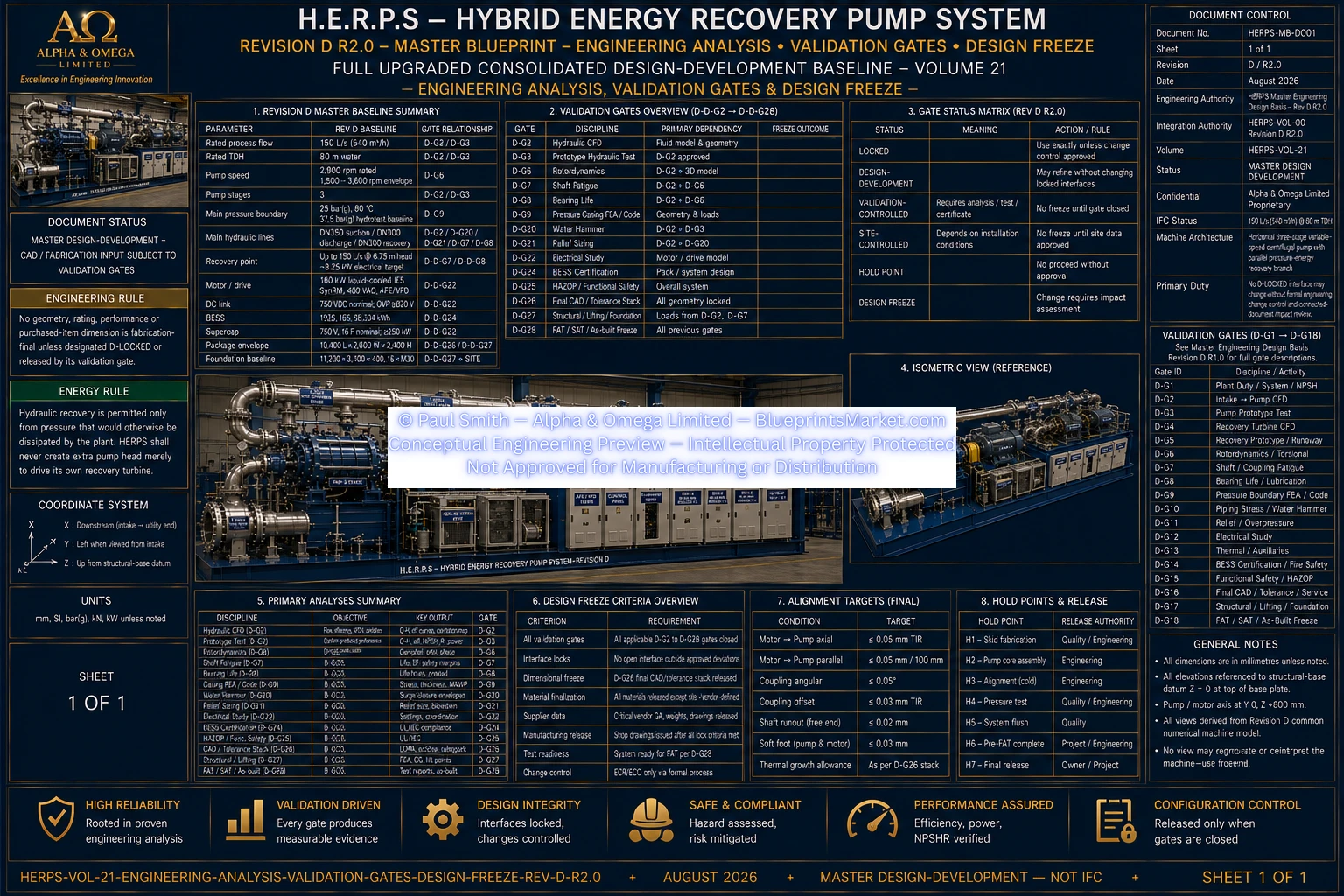
HERPS-VOL-21-ENGINEERING-ANALYSIS-VALIDATION-GATES-AND-DESIGN-FREEZE-REV-D-R2.0.webp
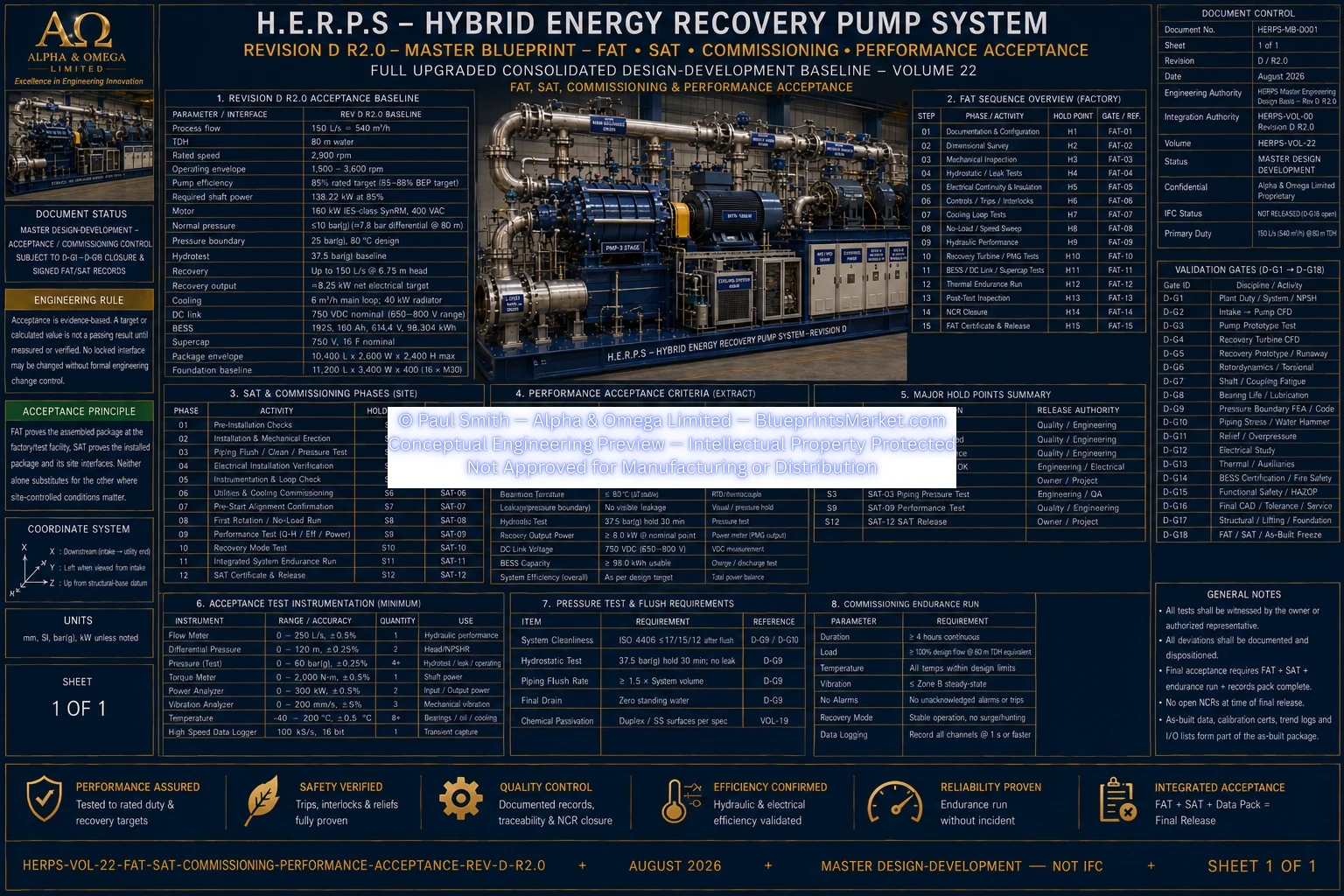
HERPS-VOL-22-FAT-SAT-COMMISSIONING-PERFORMANCE-ACCEPTANCE-REV-D-R2.0.webp
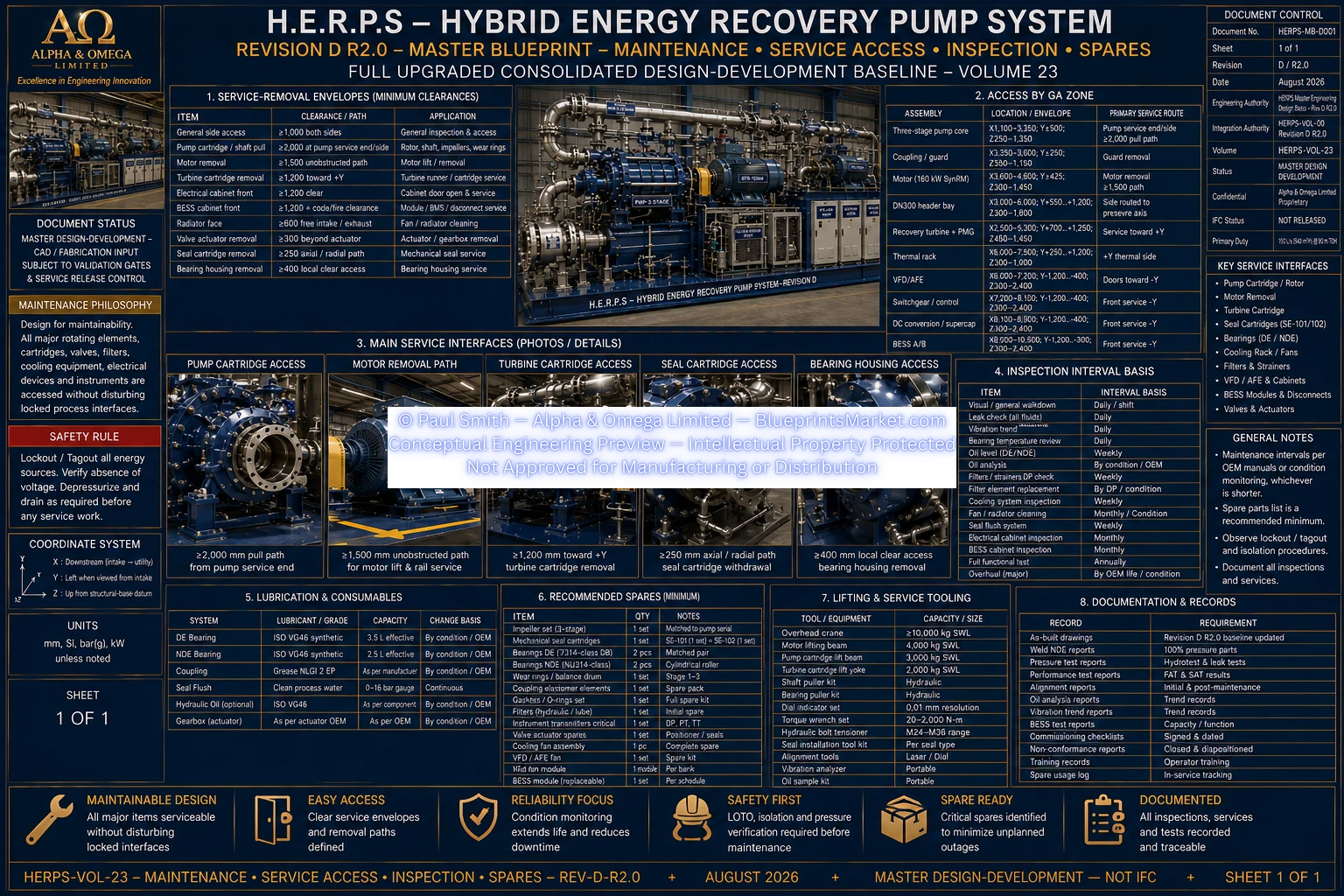
HERPS-VOL-23-MAINTENANCE-SERVICE-ACCESS-INSPECTION-SPARES-REV-D-R2.0.webp