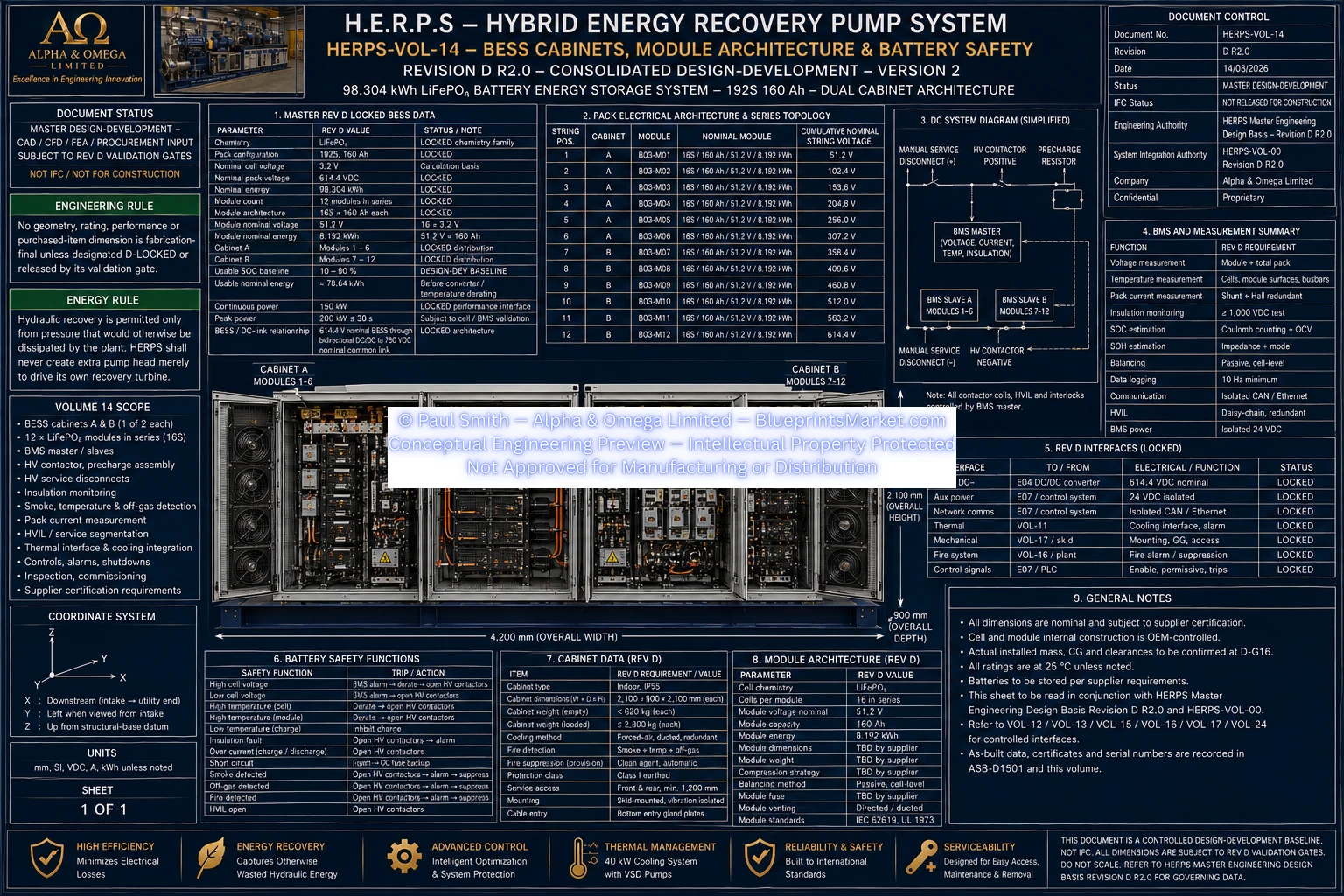
H.E.R.P.S — BESS Battery Energy Storage & Safety System
Revision D R2.0 — BESS Cabinets, Module Architecture & Battery Safety
Hybrid Energy Recovery Pump System (H.E.R.P.S)
HERPS Battery Energy Storage System Overview
The H.E.R.P.S Battery Energy Storage System (BESS) provides the integrated battery-energy storage, monitoring, isolation, thermal-management and battery-safety architecture for the Revision D hybrid energy platform.
The system uses a LiFePO4 battery architecture arranged as a 192-series-cell-equivalent battery string. Twelve 16S modules are connected in series across two dedicated BESS cabinets and interfaced with the HERPS common DC energy architecture through a bidirectional DC/DC conversion stage.
- LiFePO4 battery chemistry
- 192S / 160 Ah battery-pack architecture
- 614.4 VDC nominal battery voltage
- 98.304 kWh nominal stored energy
- Twelve 16S / 160 Ah battery modules
- Dual BESS cabinet architecture
- Integrated battery management system (BMS)
- High-voltage isolation and controlled precharge
- Battery thermal-management interfaces
- Battery-specific detection and safety functions
Revision D Battery Architecture
| Parameter | Revision D Configuration |
|---|---|
| Battery Chemistry | LiFePO4 |
| Pack Configuration | 192S / 160 Ah |
| Nominal Pack Voltage | 614.4 VDC |
| Nominal Energy | 98.304 kWh |
| Module Count | 12 modules connected in series |
| Module Architecture | 16S × 160 Ah per module |
| Nominal Module Voltage | 51.2 V |
| Nominal Module Energy | 8.192 kWh |
| Baseline Usable SOC Window | 10–90% |
| Nominal Usable Energy | Approximately 78.64 kWh before converter and temperature derating |
| BESS Continuous Power Interface | 150 kW |
| Peak Power Target | 200 kW for up to 30 seconds, subject to cell/BMS validation |
12-Module Series Energy Storage Architecture
HERPS Revision D uses twelve nominal 51.2 V, 16S / 160 Ah modules connected in series. Series connection increases the battery-string voltage while retaining the 160 Ah string capacity.
The resulting nominal electrical architecture is 614.4 VDC and 98.304 kWh. This provides a clearly defined battery interface while allowing certified battery suppliers to finalize internal cell and module construction within the controlled HERPS system requirements.
Dual BESS Cabinet System
The complete battery string is divided between two dedicated electrical cabinets, creating a structured installation and service architecture within the HERPS package.
- Cabinet A: Modules 1–6
- Cabinet B: Modules 7–12
- Six series-connected battery modules per cabinet
- Dedicated high-voltage connection zones
- Battery-management sensing and communications zones
- Service-isolation provisions
- Battery detection and monitoring interfaces
- Dedicated thermal-management provisions
Battery Management System (BMS)
The HERPS BESS incorporates a master/slave battery-management architecture responsible for monitoring battery condition and controlling whether the battery is permitted to source or accept energy.
- Cell and module voltage monitoring
- Battery temperature monitoring
- Pack-current measurement
- State-of-charge (SOC) supervision
- State-of-health (SOH) supervision
- Insulation-status monitoring
- Contactor and precharge-state monitoring
- Service-disconnect and interlock status
- Charge and discharge permissive management
- Integration with HERPS supervisory PLC/HMI architecture
Battery-protective functions are designed to remain effective independently of external cloud connectivity.
High-Voltage Switching, Precharge & Isolation
The battery system includes controlled high-voltage isolation between the BESS string and its bidirectional power-conversion interface. The architecture incorporates controlled precharge, service isolation and high-voltage status monitoring.
- Main high-voltage contactor architecture
- Controlled DC-link precharge
- Residual-energy management
- Manual service disconnects
- High-voltage interlock and status functions
- Contactor-state plausibility monitoring
- Touch-safe segmented high-voltage service architecture
Bidirectional DC/DC Energy Interface
The 614.4 V nominal battery is not connected directly to the HERPS 750 VDC nominal common link. Energy transfer is managed through the dedicated bidirectional BESS DC/DC conversion interface.
| Interface | Revision D Basis |
|---|---|
| BESS Side | 614.4 VDC nominal |
| Common DC Link | 750 VDC nominal |
| Controlled Common-Link Range | 650–800 VDC |
| DC/DC Converter Rating | 160 kW |
| BESS Continuous Power | 150 kW |
| Peak BESS Target | 200 kW for up to 30 seconds, subject to validation |
| Power Direction | Bidirectional charge and discharge |
Hybrid Energy Storage & Recovery Functions
The BESS forms part of the wider HERPS electrical energy-management architecture. Through controlled bidirectional conversion, the battery can support approved transient loads and accept genuine recovered electrical energy when battery state, temperature, voltage and system conditions permit.
- Standby energy-management mode
- Battery peak-shaving support
- Controlled ride-through support
- Recovery-energy capture
- Controlled normal charging
- Maintenance isolation mode
- Fault-isolated battery operation
BESS Cabinet Thermal Management
Revision D provides dedicated thermal-management capability for both BESS cabinets. Each cabinet is allocated an independent thermal-control system unless a selected certified battery supplier specifically approves a shared liquid circuit.
- Independent thermal control for Cabinet A and Cabinet B
- Minimum 2.5 kW heat-removal capacity per cabinet or certified equivalent
- Cell, module and cabinet temperature monitoring
- Cooling-loss detection and protective response
- Temperature-dependent charge/discharge management
- Ambient-condition derating provisions
Battery Safety, Detection & Protective Monitoring
Battery-specific safety functions are integrated into the HERPS BESS architecture to detect abnormal electrical and thermal conditions and place the battery system into an appropriate protected or isolated state.
- Battery insulation monitoring
- Pack-voltage monitoring
- Pack-current monitoring
- Cell and module voltage supervision
- Cell, module and cabinet temperature supervision
- Smoke detection
- Temperature-event detection
- Off-gas detection where compatible with the selected certified battery technology
- High-voltage contactor isolation
- Controlled charge/discharge inhibition during unsafe conditions
BESS Fault Management
Revision D defines coordinated protective responses for significant battery and high-voltage conditions while maintaining clear separation between battery protection, supervisory control and wider HERPS functional-safety systems.
- Insulation-fault response
- Battery thermal and off-gas event response
- Cell/module overvoltage protection
- Cell/module undervoltage protection
- Overcurrent and short-circuit coordination
- Precharge-failure protection
- Contactor weld or stuck-state detection strategy
- BMS communications-loss response
- Cooling-failure and overtemperature response
Service, Isolation & Maintenance Architecture
The two-cabinet configuration incorporates dedicated service and hazardous-energy controls intended to support inspection, maintenance and controlled isolation of the battery subsystem.
- Manual battery service disconnects
- Defined lockout/tagout provisions
- High-voltage stored-energy identification
- Protective cabinet bonding
- Segregated HV and low-voltage control wiring
- Service-access provisions
- Residual-energy verification requirements
- Permanent battery and high-voltage safety identification
HERPS System Integration
The BESS is integrated with multiple Revision D HERPS subsystems rather than operating as an independent battery package. Its interfaces include the common DC link, bidirectional DC/DC converter, thermal-management system, AC auxiliary distribution, PLC/HMI/SCADA controls, functional-safety system and structural skid.
- Common DC-link energy architecture
- Bidirectional BESS DC/DC conversion
- Dedicated battery thermal management
- AC auxiliary power interfaces
- PLC/HMI/SCADA monitoring
- Hardwired functional-safety integration
- Electrical-deck structural integration
- Protective bonding to the common skid system
Revision D Engineering Status
HERPS Revision D establishes the system-level BESS architecture, module count, series topology, cabinet allocation, electrical interfaces, energy-management functions, thermal requirements, monitoring architecture and safety boundaries.
Supplier-specific cell geometry, internal module construction, detailed busbar construction, final protection-device ratings, cabinet internal spacing, final cooling hardware and certified battery fire-performance details remain subject to supplier selection, validation, applicable engineering studies and site requirements.
Revision D Engineering Blueprint System
This page provides a public technical overview of the H.E.R.P.S Revision D Battery Energy Storage System. The complete engineering documentation forms part of the wider HERPS multi-volume conceptual engineering blueprint system.
Public preview material is provided for engineering-system evaluation and does not constitute an IFC, fabrication-approved or manufacturing-approved design.
Explore the Complete H.E.R.P.S Revision D System
The BESS Battery Energy Storage & Safety System is one integrated subsystem within the complete H.E.R.P.S Hybrid Energy Recovery Pump System Revision D engineering architecture.
View the Complete HERPS System
Contact Blueprints Market for product, licensing and engineering-package enquiries.