
H.E.R.P.S — Mechanical Seals, Seal Flush & Leakage Management
HERPS-VOL-05 — Revision D R2.0
Hybrid Energy Recovery Pump System (H.E.R.P.S)
Industrial pump sealing, clean-discharge seal flushing, leakage management, shaft-sleeve protection, filtration, condition monitoring and service-access engineering.
Revision D Mechanical Seal System Overview
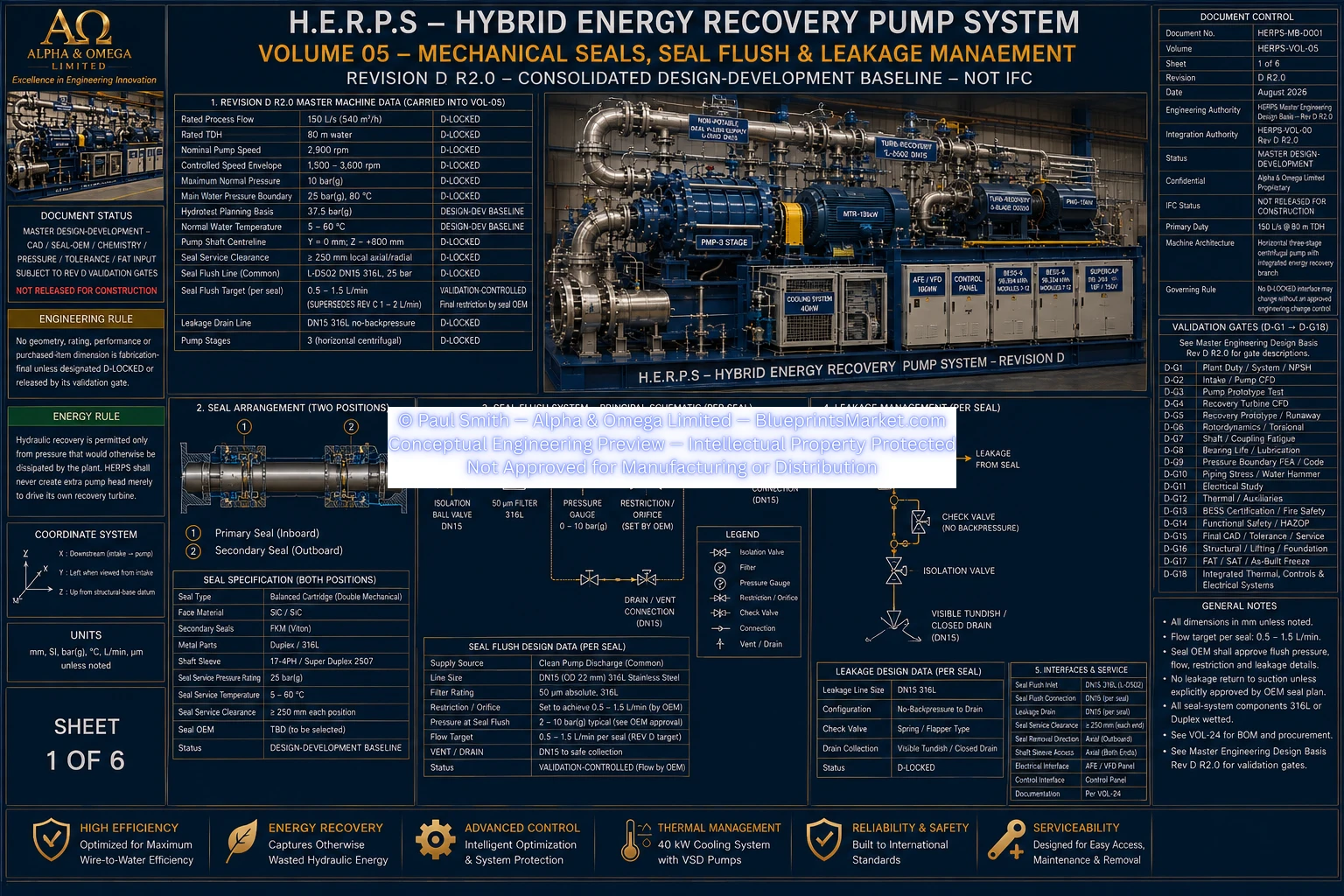
H.E.R.P.S Volume 05 defines the Revision D mechanical sealing, seal-flush and leakage-management architecture for the three-stage centrifugal pump assembly. The subsystem is engineered to maintain a controlled sealing interface around the rotating pump shaft while supporting cooling, lubrication, cleanliness, leakage control, inspection and maintainability.
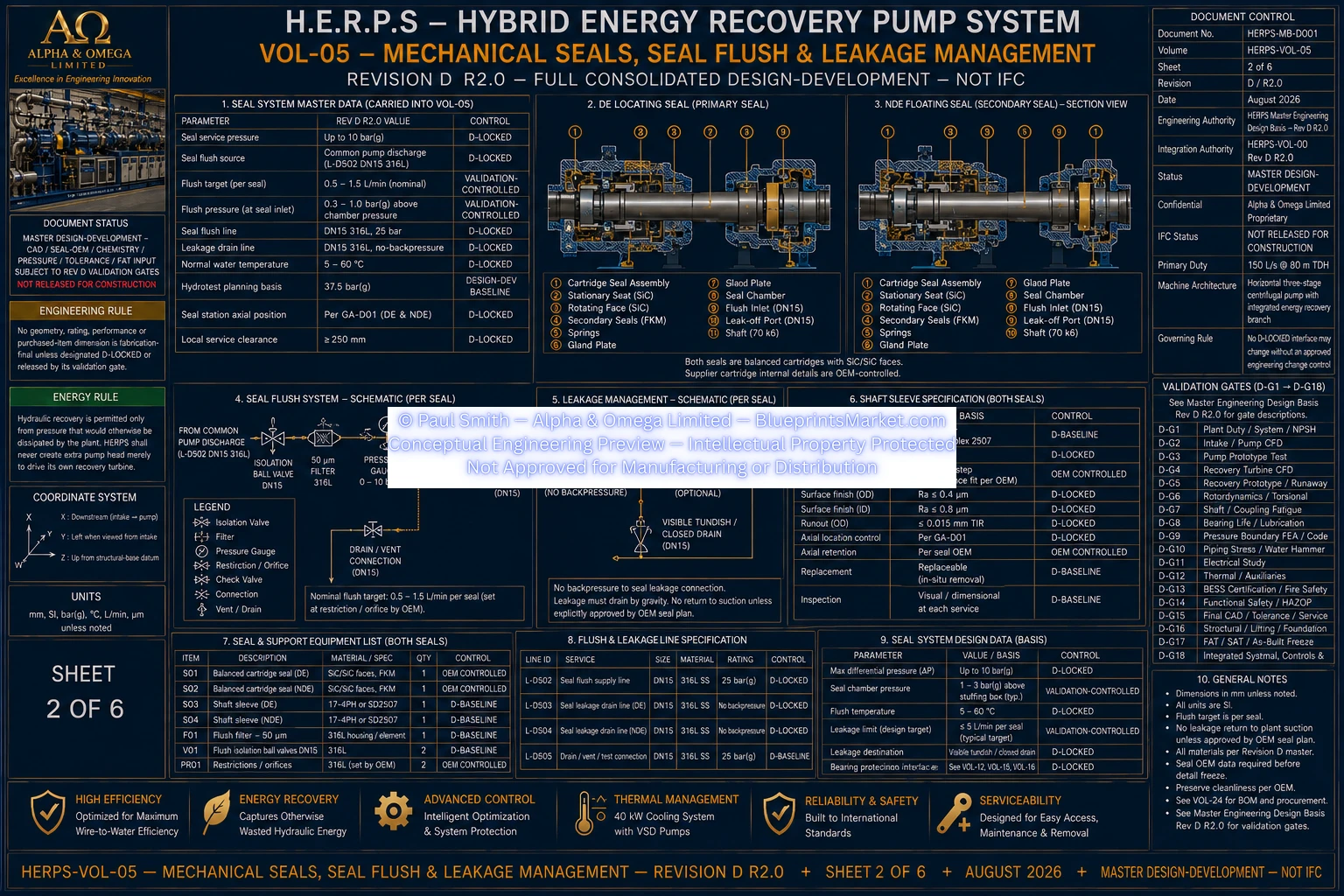
The Revision D architecture incorporates two balanced cartridge mechanical seals, replaceable precision shaft sleeves, a clean-discharge seal-flush supply, common filtration, independently controlled flush branches, pressure observation and independent leakage-drain management.
- Two balanced cartridge mechanical seals
- Silicon-carbide sealing-face architecture
- Replaceable precision shaft sleeves
- Clean-discharge seal-flush supply
- Common fine-filtration architecture
- Independent seal-flush branches
- Flush isolation and flow-control provisions
- Seal-flush pressure observation
- Independent leakage-drain management
- Integrated inspection and service-access requirements
Role Within the Complete H.E.R.P.S Pump Assembly
The seal subsystem forms the controlled interface between the rotating pump shaft and the stationary pressure-containing pump structure. Its purpose is to support reliable pump operation while preventing uncontrolled process leakage and protecting the primary shaft from unnecessary wear.
Revision D coordinates the seal system with the pump rotor, bearing housings, casing pressure boundary, main hydraulic discharge system, instrumentation, controls, maintenance requirements and final commissioning process.
- Pump rotor and shaft interface
- Bearing and housing interface
- Pump casing and pressure-boundary interface
- Main hydraulic discharge interface
- Instrumentation and monitoring interface
- Functional safety and alarm interface
- Maintenance and component-removal interface
- FAT, SAT and configuration-record interface
Balanced Cartridge Mechanical Seal Architecture
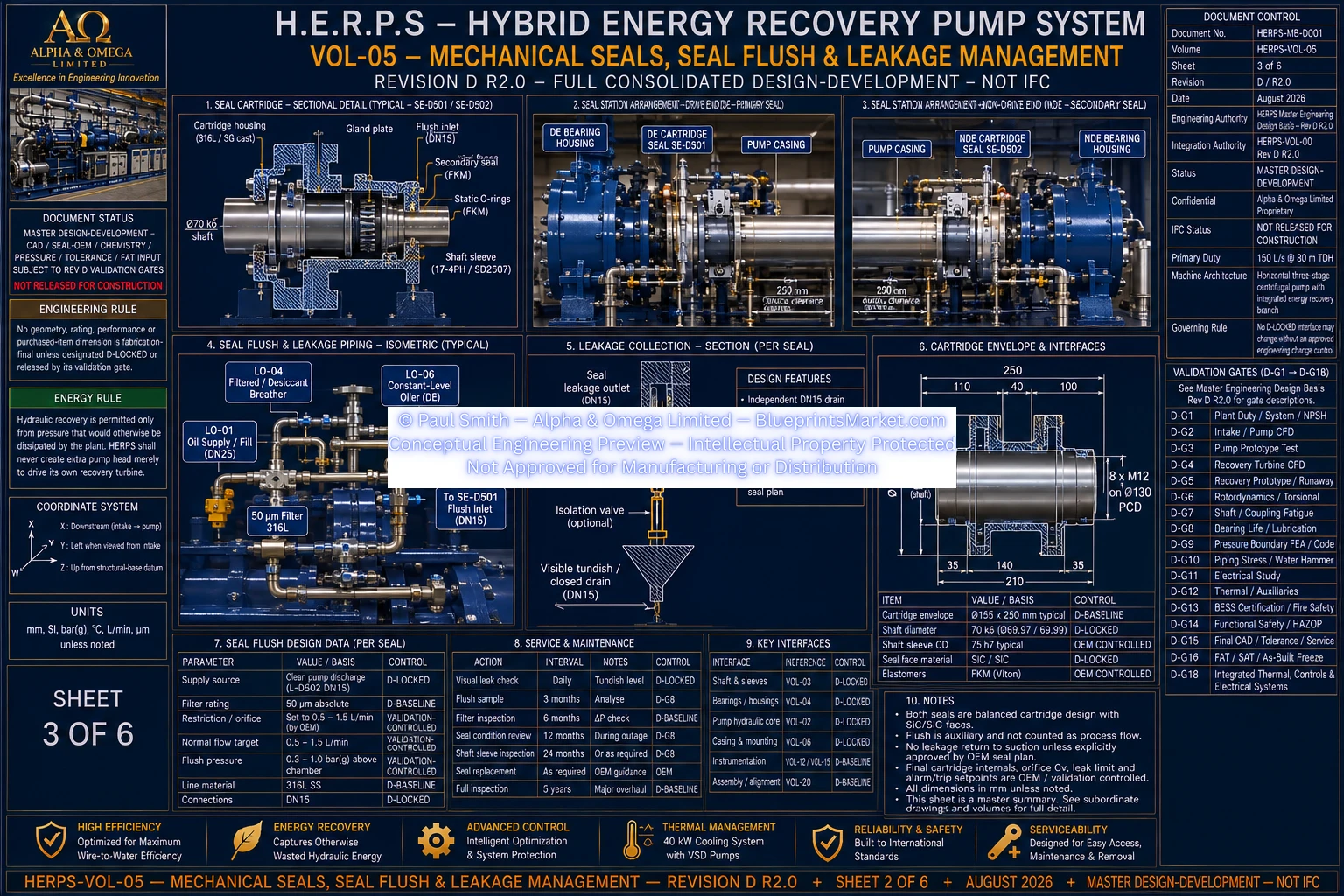
Revision D uses a two-seal cartridge architecture, with one mechanical seal installed at each controlled pump seal station. Cartridge construction allows the sealing assembly to be treated as a serviceable engineered component rather than requiring the pump shaft itself to act as the expendable sealing surface.
The Revision D baseline uses silicon-carbide sealing faces selected for industrial water-service durability, wear resistance and dimensional stability.
- Two independent cartridge seal positions
- Balanced mechanical seal architecture
- SiC / SiC sealing-face material family
- Pressure-side industrial water service
- Replaceable running surfaces
- Serviceable cartridge configuration
- OEM-controlled final internal cartridge construction
Replaceable Precision Shaft-Sleeve System
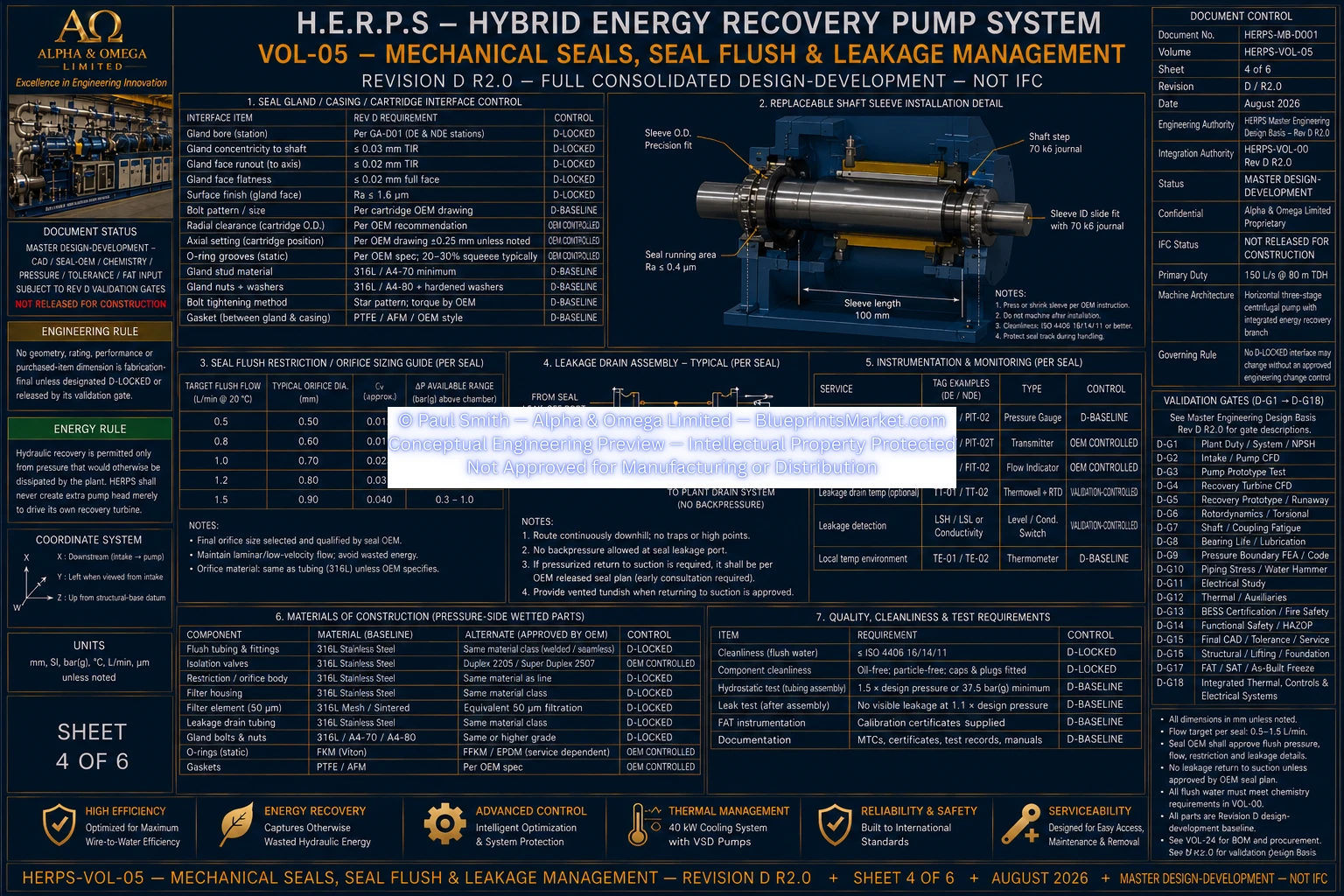
Each Revision D seal operates against a replaceable precision shaft sleeve. This architecture protects the principal pump shaft from becoming the primary sacrificial wear surface and allows sealing surfaces to be renewed without replacing the complete rotating shaft.
The sleeve material family is selected for corrosion resistance, mechanical durability and compatibility with the intended water service and selected seal.
- Two replaceable shaft sleeves
- Precision-machined seal running surfaces
- Corrosion-resistant material family
- Controlled surface-finish requirements
- Inspection for scratching, corrosion, burrs and wear
- Replaceable without sacrificing the primary pump shaft
Clean-Discharge Seal-Flush Architecture
The H.E.R.P.S Revision D seal-flush system derives its pressure-side supply from clean pump discharge before the main hydraulic flow divides between the normal process path and the hydraulic energy-recovery branch.
This arrangement keeps seal-flush availability independent of whether the recovery subsystem is operating and prevents energy-recovery operation from depriving either seal of its required clean-water supply.
- Clean pump-discharge flush source
- Flush source independent of energy-recovery branch operation
- Common upstream filtration
- Two independent downstream seal branches
- Pressure-side stainless-steel service architecture
- Controlled parasitic flush consumption
Seal-Flush Filtration
Revision D incorporates a common replaceable fine-filter arrangement upstream of the two individual seal-flush branches. The filtration system reduces the possibility of particulate contamination reaching the mechanical sealing faces.
The filter is designed as a maintainable service component so that its element can be inspected or replaced without requiring removal of the mechanical seal cartridges.
- Common seal-flush filtration
- Replaceable filter-element architecture
- Industrial stainless-steel pressure-side construction family
- Service access independent of cartridge removal
- Optional differential-pressure monitoring depending on selected equipment
Independent Seal-Flush Branch Control
Downstream of the common filter, the flush system divides into two independent branches so that each cartridge seal receives its own controlled clean-water supply.
Each branch provides isolation, pressure observation and an OEM-selected restriction or equivalent flow-control device. This allows the actual flush flow to be matched to the requirements of the selected mechanical seal rather than relying on arbitrary generic settings.
- Independent branch isolation
- Independent pressure observation
- Dedicated flow restriction for each seal
- Serviceable small-bore piping architecture
- Revision D reduced-flush optimization philosophy
- Final flow requirement controlled by selected seal OEM data
Revision D Seal-Flush Efficiency Optimization
Revision D reduces unnecessary auxiliary clean-water consumption by introducing an optimized seal-flush development target while preserving the requirement that final flow must remain sufficient for reliable mechanical-seal operation.
The current development target is approximately 0.5–1.5 L/min per seal, subject to final seal-manufacturer requirements, pressure conditions, fluid properties and thermal behaviour.
This value is an engineering development target rather than an artificial maximum. If the selected seal requires a different approved flow for reliable operation, the validated OEM requirement governs.
Independent Leakage Management
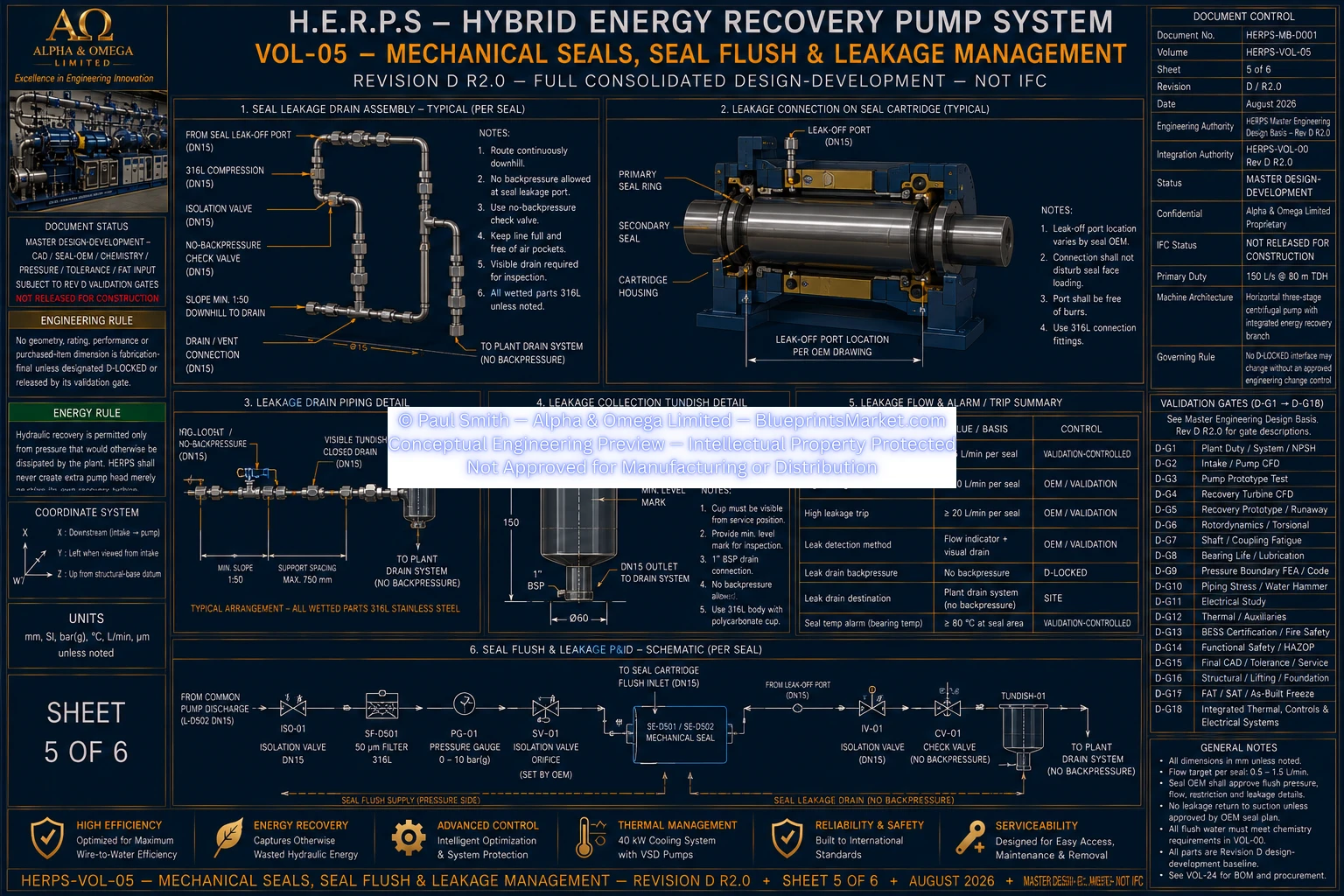
Each mechanical seal has an independent leakage-management path so that seal leakage can be safely observed, routed and assessed without combining the two seal positions into an uncontrolled common pressure connection.
The Revision D architecture requires leakage drainage to remain free-flowing and without imposed backpressure on the cartridge leakage cavity.
- Independent leakage path for each seal
- No-backpressure drainage philosophy
- Visible or controlled closed-drain interface
- Drain routing separated from pressure-side seal flushing
- Optional leakage detection for critical installations
- Site-specific final drainage connection
Industrial Materials & Water-Service Compatibility
Revision D specifies industrial corrosion-resistant material families for the seal-flush and rotating sealing interfaces while allowing final elastomer selection to be matched to actual site water chemistry and operating conditions.
- Silicon-carbide mechanical seal faces
- Corrosion-resistant replaceable shaft-sleeve materials
- 316L-family seal-flush components
- Industrial pressure-rated filtration and isolation hardware
- EPDM clean-water development baseline
- Alternative elastomer selection where actual chemistry requires it
Final material compatibility is confirmed against actual water chemistry, operating temperature, cleaning agents and selected supplier data.
Pressure-Side Seal System Engineering
Pressure-side seal-flush components are coordinated with the governing Revision D water-system pressure class so the cartridge seals, filtration, isolation, instrumentation and small-bore piping remain compatible with the pump pressure boundary.
Supplier certification, pressure testing and final component selection remain controlled through the appropriate Revision D validation and OEM release process.
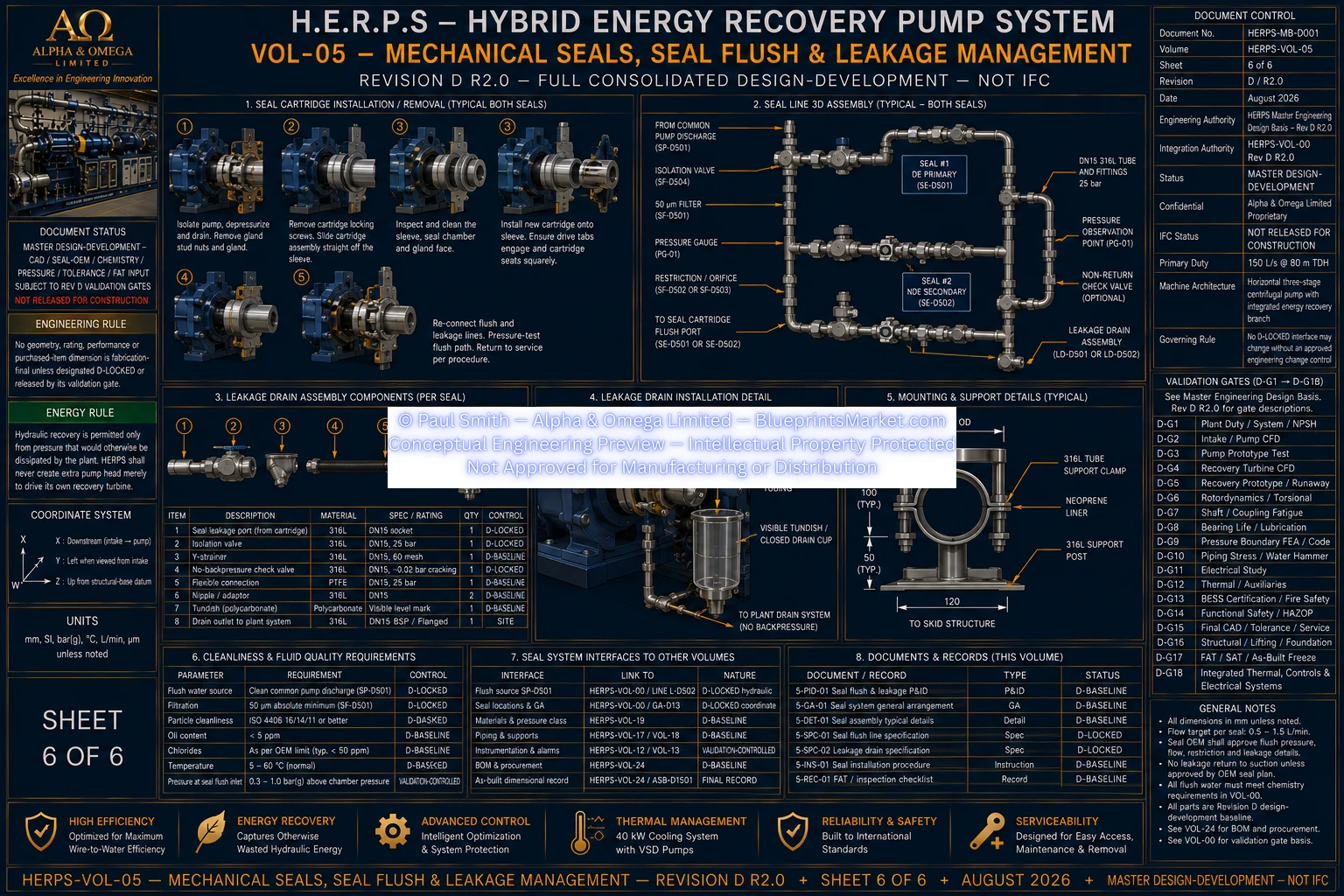
Serviceability & Mechanical Seal Replacement
Mechanical-seal serviceability is designed into the H.E.R.P.S Revision D package. Seal-flush tubing, instruments, filter hardware and nearby equipment are arranged so they do not unnecessarily obstruct cartridge removal or adjacent bearing maintenance.
- Dedicated cartridge-removal access
- Adjacent bearing-service access preserved
- Removable flush connections
- Accessible isolation valves
- Accessible pressure observation points
- Serviceable filter element
- Disconnectable leakage-drain connections
- Maintenance without cutting permanent main process piping
Cleanliness & Contamination Control
Mechanical seal reliability depends heavily on installation cleanliness. Revision D therefore treats seal-flush cleanliness as an engineering requirement rather than a commissioning afterthought.
- Seal system capped and protected during assembly
- Flush piping cleaned before final cartridge connection
- Filter installed before normal seal-flush operation
- No construction debris permitted in seal-flush branches
- Small-bore piping supported independently
- Routing avoids rubbing, vibration and contamination traps
Seal Condition Monitoring
Revision D supports ongoing monitoring of the mechanical sealing system through direct inspection and available process instrumentation.
- Seal-flush pressure observation
- Seal-flush flow verification during commissioning
- Visible leakage-condition monitoring
- Filter-condition monitoring where equipped
- Shaft-sleeve inspection during cartridge maintenance
- Inspection for abnormal leakage, overheating, noise or rubbing
- Configuration recording following seal replacement
Seal-System Failure Prevention & Engineering Controls
Volume 05 identifies the major operating conditions capable of reducing mechanical-seal reliability and addresses them through coordinated hydraulic, mechanical and maintenance controls.
- Insufficient flush protection
- Excessive auxiliary flush-water control
- Filter blockage management
- Dry-running prevention after service
- Shaft-sleeve wear and scoring inspection
- Water-chemistry and elastomer compatibility control
- Cartridge alignment control
- Leakage-drain backpressure prevention
- Small-bore tubing vibration control
- Maintenance-access preservation
- Pressure-transient compatibility
Inspection, Quality Control & Commissioning
Revision D provides a defined inspection and acceptance framework covering the seal cartridges, shaft sleeves, casing interfaces, filtration components, flush branches, leakage drains, installation condition and operating verification.
Typical validation activities include:
- Mechanical seal receipt inspection
- Shaft-sleeve dimensional and surface inspection
- Gland and casing interface inspection
- Filter, valve and restriction verification
- Seal-flush tubing cleanliness inspection
- Leakage-drain free-flow verification
- Mechanical cartridge installation inspection
- Commissioning flush-flow verification
- Running inspection for abnormal leakage or heating
- Physical demonstration of required service access
- Final configuration and inspection records
Cross-System Revision D Integration
The mechanical seal subsystem is coordinated with multiple other H.E.R.P.S Revision D engineering volumes so that shaft geometry, bearing access, pressure containment, hydraulic routing, instrumentation, assembly and maintenance requirements remain consistent throughout the complete machine.
- System Integration & General Arrangement
- Three-Stage Centrifugal Pump Hydraulic Core
- Pump Rotor, Shaft & Rotating Assembly
- Pump Bearings, Housings & Lubrication
- Pump Casing & Pressure Boundary
- Main Hydraulic Piping & Flow Control
- PLC / HMI / SCADA & Instrumentation
- Functional Safety & Hardwired Protection
- Assembly, Installation & Alignment
- Engineering Validation & Design Freeze
- FAT / SAT & Commissioning
- Maintenance, Service Access & Inspection
- Configuration & As-Built Record Control
Revision D Engineering Status
HERPS-VOL-05 Revision D R2.0 is a consolidated design-development engineering definition.
The system establishes the coordinated sealing architecture and public design basis, while final supplier-specific cartridge internals, gland construction, exact restriction geometry, final instrument selections, final alarm settings and site drainage interfaces remain controlled by the applicable OEM, engineering validation and site-specific release process.
This prevents unresolved supplier or site information from being presented as fabrication-final engineering data.
HERPS Volume 05 — Revision D Blueprint Preview
The following watermarked engineering blueprint sheets provide a public visual preview of the Revision D mechanical seals, seal flush and leakage-management documentation contained within the H.E.R.P.S engineering package.
H.E.R.P.S Revision D Blueprint Access & Licensing
Mechanical Seals, Seal Flush & Leakage Management is Volume 05 of the complete H.E.R.P.S Revision D R2.0 engineering documentation architecture.
The complete H.E.R.P.S package extends across hydraulic, mechanical, rotating-equipment, pressure-boundary, electrical, energy-recovery, thermal, control, functional-safety, structural, fabrication, installation, validation, commissioning, maintenance and configuration disciplines.
Public pages and watermarked blueprint images provide an engineering preview. The licensed engineering documentation contains the corresponding controlled design-development information subject to the Blueprints Market license and applicable validation requirements.
View Complete H.E.R.P.S Revision D System
View Blueprint Package & Pricing | View Licensing | Contact Blueprints Market
Engineering Development Notice
H.E.R.P.S Revision D R2.0 is a controlled master design-development engineering baseline. It is not represented as an IFC construction release, fabrication-final drawing set, supplier-certified production design or measured as-built configuration.
Final mechanical seal manufacturer and model, cartridge internal construction, gland details, final flow-restriction geometry, elastomer selection, instrumentation, alarm and trip settings, final leakage acceptance requirements and site drain connections remain subject to the applicable supplier, validation, commissioning and site-specific engineering processes.