H.E.R.P.S — Energy Storage, DC Switching & Supercapacitor System
Revision D R2.0 — Common DC Link • DC/DC Conversion • Supercapacitor • BESS • Switching & Protection
Hybrid Energy Recovery Pump System (H.E.R.P.S)
Revision D Energy Storage & Switching Architecture
The H.E.R.P.S Revision D R2.0 energy-storage architecture combines the
common DC-link system, bidirectional DC/DC conversion, supercapacitor
transient-energy subsystem, LiFePO₄ battery energy-storage system,
high-voltage switching, isolation, protection and supervisory control
into one coordinated electrical-energy platform.
The architecture manages recovered electrical energy and transient power
exchange without representing the machine as self-powering. The main pump
remains capable of normal grid-supplied operation while the energy-storage
systems provide controlled buffering, transient support and energy-management
functions.
- 750 VDC nominal common DC link
- Controlled DC operating envelope
- Bidirectional BESS DC/DC conversion
- 750 V class supercapacitor subsystem
- Short-duration high-power transient support
- LiFePO₄ battery energy storage
- Battery Management System supervision
- High-voltage switching and isolation
- Precharge and controlled DC-link discharge
- Electrical fault protection
- PLC / HMI / SCADA monitoring
750 VDC Common DC-Link System
The Revision D common DC link forms the central DC-energy interface between
compatible regenerative conversion equipment, energy-storage converters
and transient-energy devices.
| Parameter |
Revision D R2.0 Baseline |
| Nominal DC-Link Voltage |
750 VDC |
| Controlled Operating Range |
650–800 VDC |
| Hardware Overvoltage Protection Baseline |
≥820 VDC |
| Primary Function |
Central controlled DC-energy transfer interface |
| Connected Functions |
DC/DC conversion, supercapacitor system, BESS interface and regenerative power architecture |
DC-Link Functional Architecture
- Controlled DC energy transfer between compatible electrical subsystems
- Regenerative-energy acceptance
- Bidirectional storage-system interfacing
- Transient-energy buffering
- DC-bus voltage monitoring
- Current monitoring
- Controlled precharge
- Controlled discharge
- Fault isolation
- Overvoltage and undervoltage protection
Bidirectional BESS DC/DC Converter
The battery-energy-storage interface uses controlled bidirectional DC/DC
conversion between the BESS voltage domain and the common DC link.
| Parameter |
Revision D R2.0 Baseline |
| Converter Function |
Bidirectional BESS DC/DC conversion |
| Continuous Power |
160 kW |
| Short-Duration Peak Baseline |
200 kW for ≤30 seconds |
| Energy Direction |
Charge and discharge |
| Primary Interface |
BESS ↔ Common DC Link |
Converter operation remains subject to DC-link voltage, BESS limits,
battery-management permissions, electrical protection and the applicable
machine operating mode.
Supercapacitor Transient-Energy System
The supercapacitor subsystem is the rapid-response energy buffer within the
H.E.R.P.S Revision D DC architecture. It is intended for short-duration,
high-power charge and discharge events rather than long-duration stored-energy
duty.
| Parameter |
Revision D R2.0 Baseline |
| Voltage Class |
750 VDC |
| Capacitance |
16 F |
| Converter Function |
Bidirectional |
| Short-Duration Power Class |
≥250 kW |
| Primary Duty |
Transient-energy buffering and rapid DC-system support |
Transient Power Management
- Fast regenerative-energy absorption
- Rapid discharge during transient demand
- Common DC-link voltage support
- Short-duration power buffering
- Reduction of rapid cycling demand placed upon the BESS
- Coordinated charge and discharge through controlled power conversion
Battery Energy Storage System — BESS
H.E.R.P.S Revision D uses a dedicated LiFePO₄ battery energy-storage system
divided across two cabinet zones and supervised by the Battery Management
System.
| BESS Parameter |
Revision D R2.0 Baseline |
| Battery Chemistry |
LiFePO₄ |
| Series Configuration |
192S |
| Capacity |
160 Ah |
| Nominal Pack Voltage |
614.4 VDC |
| Nominal Stored Energy |
98.304 kWh |
| Module Architecture |
12 × 16S / 160 Ah modules |
| Cabinet Architecture |
Two cabinet zones |
BESS Cabinet Architecture
BESS Cabinet A
- Modules 1–6
- LiFePO₄ battery modules
- Battery monitoring
- HV electrical interfaces
- Service and isolation provisions
BESS Cabinet B
- Modules 7–12
- LiFePO₄ battery modules
- Battery monitoring
- HV electrical interfaces
- Service and isolation provisions
Battery Management System
The BMS supervises battery operating condition and provides the battery-specific
protective layer required for controlled operation of the energy-storage system.
- Module and pack monitoring
- Voltage supervision
- Temperature supervision
- State-of-charge monitoring
- Battery protection status
- Charge and discharge permissions
- Fault detection
- Protective isolation commands
- Communication with the H.E.R.P.S control system
High-Voltage Switching & Isolation
The Revision D energy architecture includes controlled high-voltage
switching and isolation so the DC link, BESS and related energy-storage
equipment can be safely connected, disconnected and placed into defined
service states.
- HV contactor / switching functions
- Controlled BESS connection and isolation
- DC-link isolation
- Precharge sequencing
- Controlled discharge sequencing
- Fault-triggered isolation
- Maintenance isolation
- Interlocked switching logic
DC-Link Precharge & Discharge Control
High-capacitance DC systems cannot be connected as an uncontrolled step
load. Revision D therefore incorporates controlled precharge and discharge
functions as part of the switching architecture.
- Verify required electrical permissives.
- Verify acceptable DC-system condition.
- Initiate controlled precharge.
- Monitor DC-link voltage rise.
- Close the permitted main HV switching path after successful precharge.
- Monitor system status during operation.
- Open switching devices when isolation is commanded.
- Discharge retained DC-link energy through the controlled discharge path.
Plant AC Switching & Regenerative Drive Interface
The energy-storage architecture interfaces with the wider H.E.R.P.S
electrical system through the Revision D AC switchgear and regenerative
AFE/VFD architecture.
- 400 VAC plant electrical interface
- 400 A-class main isolator / switchgear development baseline
- ≥180 kW regenerative AFE/VFD class
- Protected AC distribution
- Controlled isolation
- Drive-system fault protection
- Integration with the common DC architecture
Energy-Storage Operating Philosophy
The H.E.R.P.S Revision D battery and supercapacitor systems support the
machine's managed energy architecture. They do not create additional energy
and do not replace the external source required to operate the main pump.
The pump remains capable of grid-powered operation with the BESS isolated.
Recovered electrical energy may be managed through the common DC architecture
only where the corresponding hydraulic recovery energy is genuinely available.
- No perpetual-energy claim
- No self-powering claim
- Grid-powered primary pump operation
- Controlled recovery-energy storage
- BESS may be isolated without preventing normal grid-powered pump operation
- Supercapacitor used for transient rather than long-duration energy storage
Grid Export & External Energy Interface
Grid export is not enabled by default within the Revision D baseline.
Export capability requires separate engineering, protection studies,
utility coordination and formal approval before implementation.
- Grid export disabled in the baseline configuration
- No uncontrolled regenerative export
- Separate engineering required for export functionality
- Protection and utility requirements must be independently resolved
Electrical Protection Architecture
Revision D combines hardware protection, power-electronic protection,
BMS protection and supervisory control rather than relying upon one
software layer for electrical safety.
DC-Link Protection
- Overvoltage protection
- Undervoltage monitoring
- Overcurrent protection
- Controlled isolation
- Precharge monitoring
BESS Protection
- BMS supervision
- Battery voltage monitoring
- Battery temperature monitoring
- Charge/discharge protection
- HV isolation
Converter Protection
- Overcurrent protection
- DC-voltage monitoring
- Thermal protection
- Converter fault shutdown
- Communication status monitoring
System Protection
- Hardwired trip integration
- Electrical interlocks
- Emergency isolation
- Fault annunciation
- Maintenance lockout provisions
PLC, HMI & SCADA Energy Monitoring
Revision D integrates electrical-energy data into the wider H.E.R.P.S
PLC/HMI/SCADA architecture so the storage and switching systems can be
monitored alongside the hydraulic and mechanical systems.
- DC-link voltage monitoring
- DC-link current monitoring
- DC/DC converter operating status
- Supercapacitor status
- BESS voltage and operating status
- BESS state of charge
- BMS protection state
- Switching-device state
- Precharge state
- Electrical alarms and trips
- Historical energy data
- Operator diagnostics
Typical Energy-System Operating States
| State |
Purpose |
| Isolated |
Energy-storage subsystem disconnected from the common DC architecture |
| Precharge |
Controlled charging of the DC-link capacitance prior to main connection |
| Standby |
System energized and available without commanded energy transfer |
| BESS Charge |
Controlled transfer of permitted energy into battery storage |
| BESS Discharge |
Controlled transfer of battery energy to the DC architecture |
| Supercapacitor Charge |
Rapid transient-energy absorption |
| Supercapacitor Discharge |
Rapid short-duration power support |
| Fault Isolation |
Automatic or commanded isolation following a detected abnormal condition |
Revision D System Interfaces
- Volume 10 — Recovery PMG and active rectifier interface
- Volume 12 — VFD / AFE / switchgear / AC power distribution
- Volume 13 — Common DC link / DC-DC / supercapacitor system
- Volume 14 — BESS cabinets / modules / BMS / battery safety
- Volume 15 — PLC / HMI / SCADA / instrumentation / field I/O
- Volume 16 — Functional safety / hardwired trips / cybersecurity
Revision D Engineering Status
This page presents the public Revision D R2.0 energy-storage and switching
architecture. It does not replace supplier-certified battery data,
converter certification, final protection studies, final cable schedules,
final settings or the signed as-built configuration record.
Final vendor models, final converter parameters, final BMS settings,
final protection settings, detailed cable sizing and other controlled
implementation information remain subject to the applicable engineering,
procurement, validation, FAT/SAT and as-built processes.
Explore the Complete H.E.R.P.S Revision D System
The common DC link, DC/DC conversion, supercapacitor and BESS architecture
forms part of the complete H.E.R.P.S Revision D multi-volume conceptual
engineering system.
View the Complete HERPS System
Contact Blueprints Market for product,
blueprint-package and licensing enquiries.
REVISION D — ENERGY STORAGE • DC SWITCHING • POWER CONVERSION • CONTROL
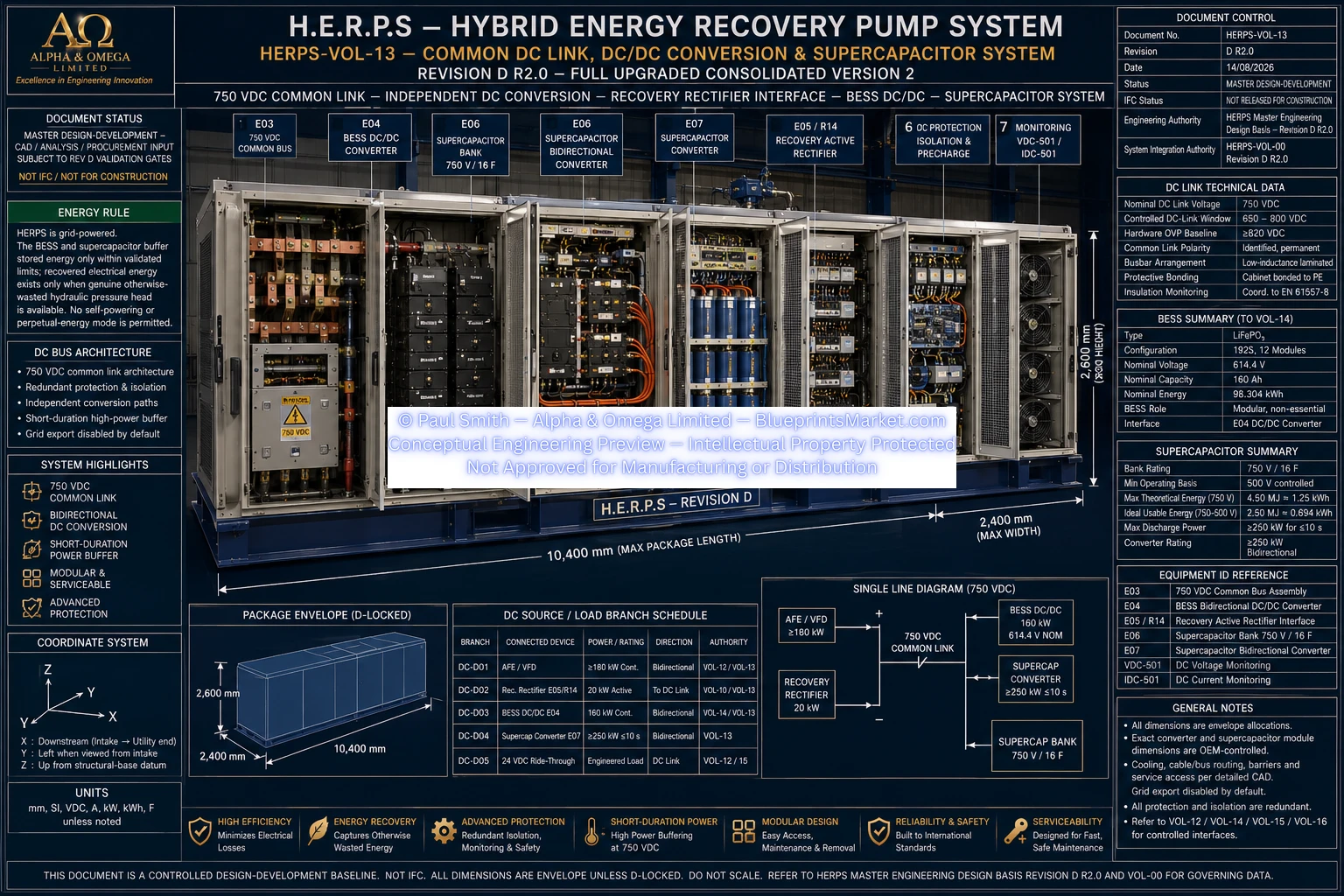
© Paul Smith — Alpha & Omega Limited — PlatformClouds.com — Conceptual Engineering Preview — Not Approved for Manufacturing
HERPS-VOL-13-COMMON-DC-LINK-DC-DC-CONVERSION-AND-SUPERCAPACITOR-SYSTEM-REV-D-R2.0.webp
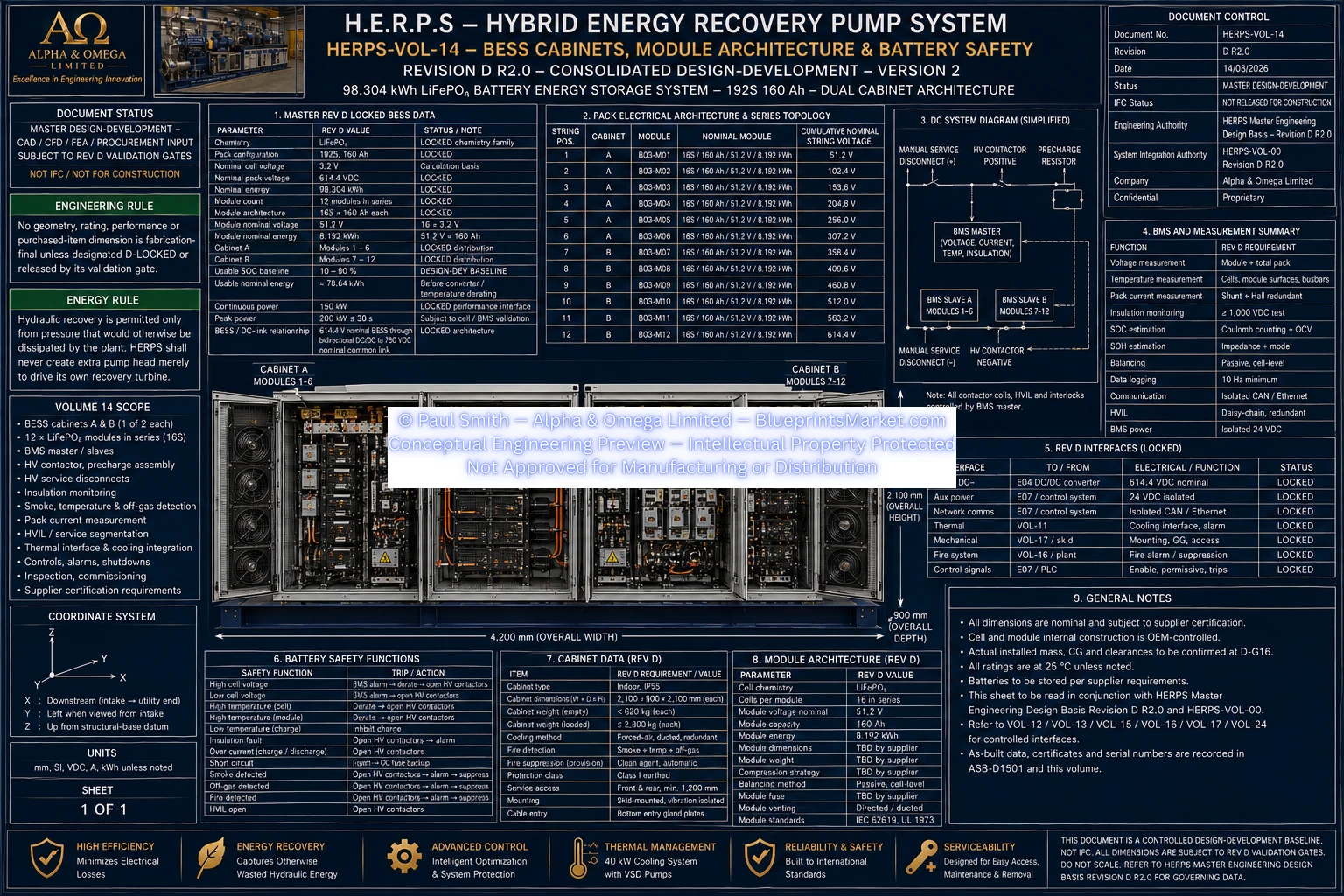
© Paul Smith — Alpha & Omega Limited — PlatformClouds.com — Conceptual Engineering Preview — Not Approved for Manufacturing
HERPS-VOL-14-BESS-CABINETS-MODULE-ARCHITECTURE-AND-BATTERY-SAFETY-REV-D-R2.0.webp
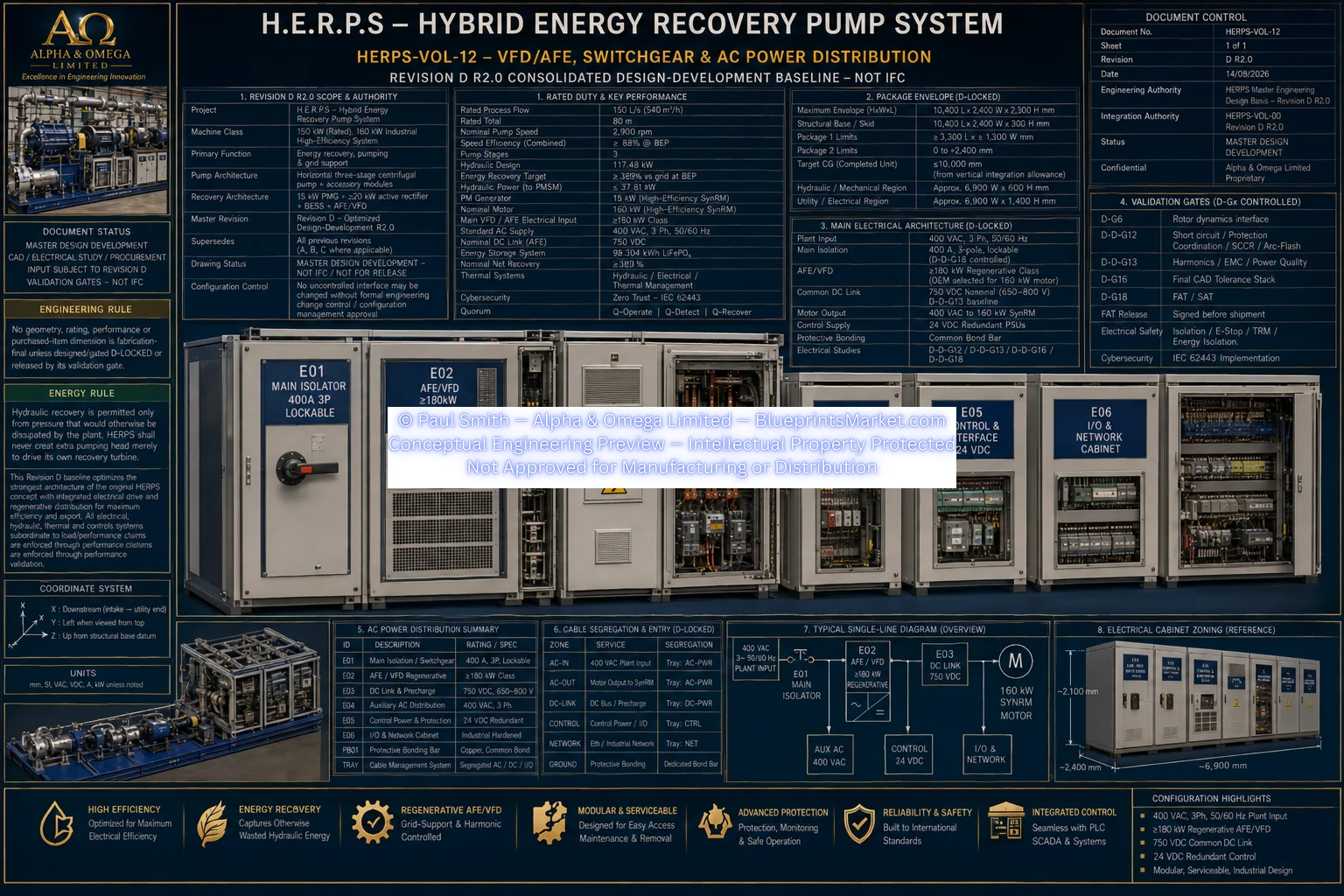
© Paul Smith — Alpha & Omega Limited — PlatformClouds.com — Conceptual Engineering Preview — Not Approved for Manufacturing
HERPS-VOL-12-VFD-AFE-SWITCHGEAR-AND-AC-POWER-DISTRIBUTION-REV-D-R2.0.webp
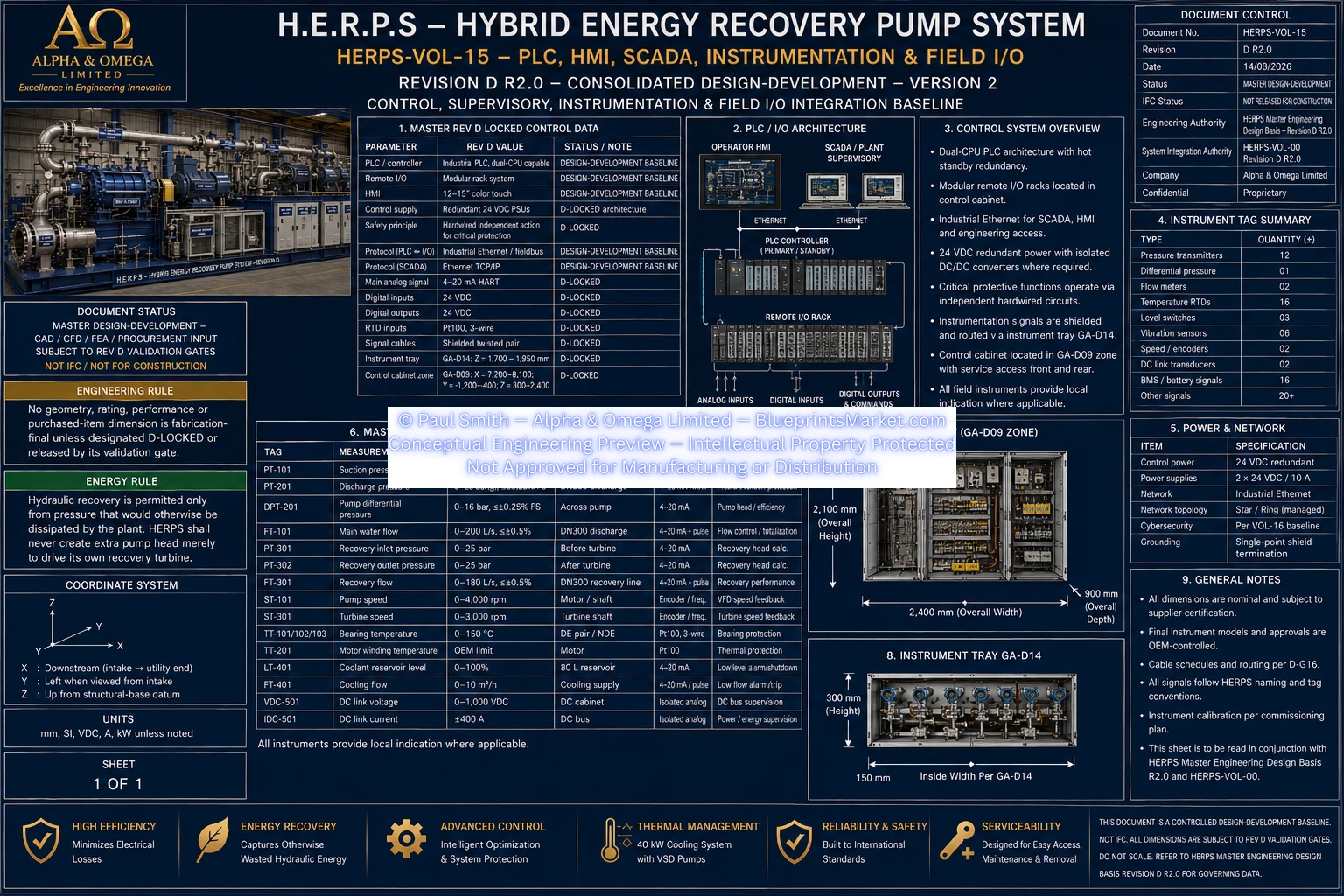
© Paul Smith — Alpha & Omega Limited — PlatformClouds.com — Conceptual Engineering Preview — Not Approved for Manufacturing
HERPS-VOL-15-PLC-HMI-SCADA-INSTRUMENTATION-AND-FIELD-IO-REV-D-R2.0.webp