© Paul Smith — Alpha & Omega Limited — PlatformClouds.com — Conceptual Engineering Preview — Not Approved for Manufacturing
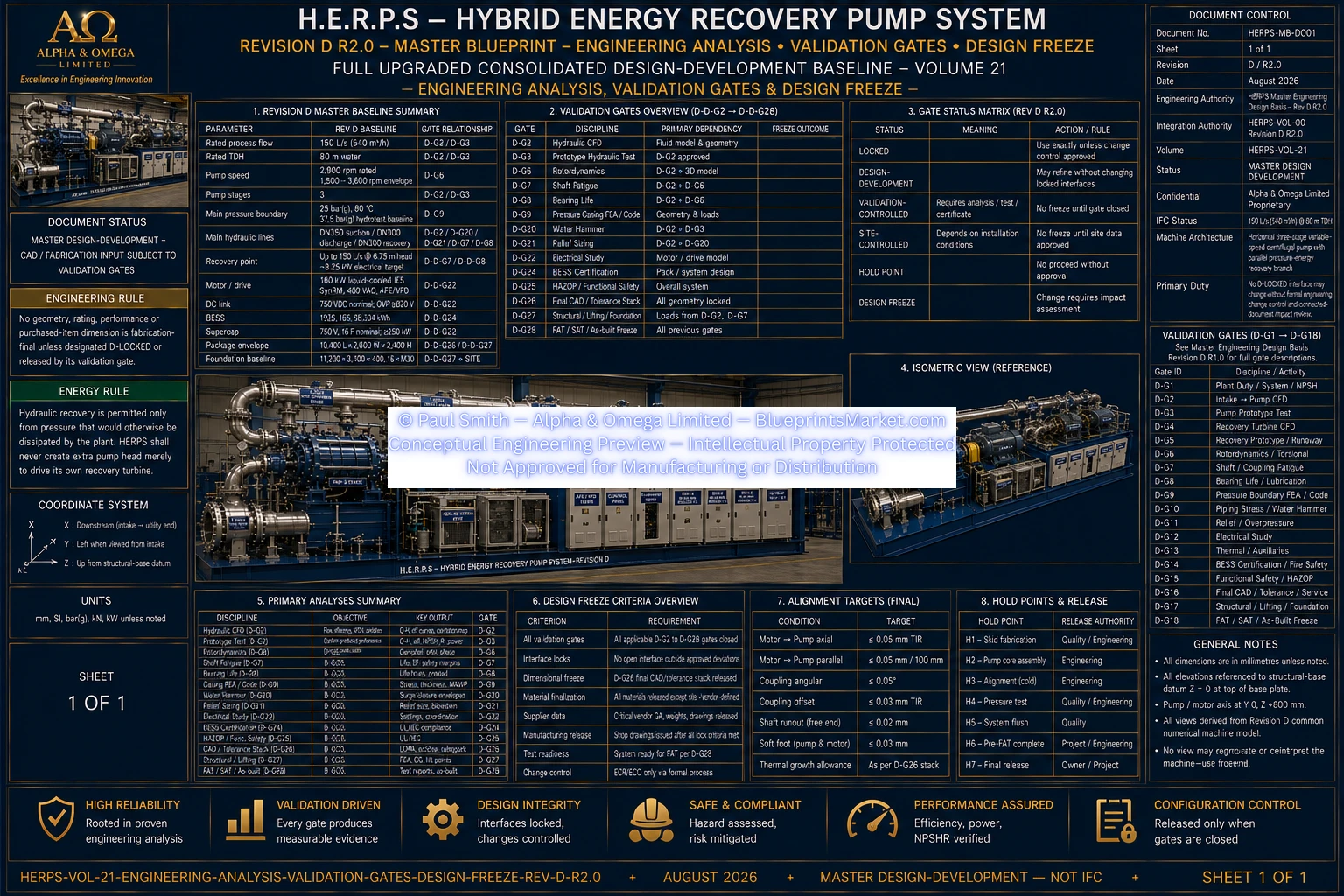
HERPS-VOL-21-ENGINEERING-ANALYSIS-VALIDATION-GATES-AND-DESIGN-FREEZE-REV-D-R2.0.webp

Revision D R2.0 — Validation Gates • Engineering Evidence • Design Freeze • FAT/SAT Acceptance
Hybrid Energy Recovery Pump System (H.E.R.P.S)
H.E.R.P.S Revision D R2.0 uses a formal engineering-analysis, validation-gate and design-freeze framework to control progression from design-development through testing, acceptance and eventual as-built configuration.
The validation program does not treat preliminary calculations, design targets, simulations or CAD geometry as automatically verified. Final release depends on objective engineering evidence appropriate to each subsystem and validation gate.
| Parameter | Revision D R2.0 Baseline |
|---|---|
| System | H.E.R.P.S — Hybrid Energy Recovery Pump System |
| Pump Architecture | Horizontal three-stage variable-speed centrifugal industrial water pump |
| Rated Hydraulic Duty | 150 L/s at 80 m TDH |
| Rated Pump Speed | 2,900 rpm |
| Main Drive Baseline | 160 kW-drive-class architecture |
| Recovery Principle | Recovery only from genuinely available otherwise-wasted pressure reduction |
| Engineering Status | Master Design-Development — Not IFC / Not Shop Release until applicable validation gates are closed |
Volume 21 expands the earlier validation program into the Revision D D-G1 through D-G18 gate structure. Each gate represents a controlled engineering release point rather than a simple checklist item.
| Gate | Validation Area |
|---|---|
| D-G1 | Plant duty, system curve, site NPSH and recoverable-head validation |
| D-G2 | Integrated intake and pump CFD |
| D-G3 | Pump prototype hydraulic test |
| D-G4 | Recovery-turbine CFD |
| D-G5 | Recovery prototype / runaway validation |
| D-G6 | Pump and recovery-machine rotordynamics / torsional validation |
| D-G7 | Shaft and coupling fatigue |
| D-G8 | Bearing life and lubrication |
| D-G9 | Pressure-boundary FEA / code verification |
| D-G10 | Piping stress and water-hammer validation |
| D-G11 | Relief and overpressure protection |
| D-G12 | Electrical-system study |
| D-G13 | Thermal and auxiliary-power validation |
| D-G14 | BESS certification and fire safety |
| D-G15 | Functional safety, HAZOP and cybersecurity |
| D-G16 | Final CAD, tolerance and service stack |
| D-G17 | Structural, lifting and foundation validation |
| D-G18 | FAT/SAT and final as-built design freeze |
Revision D separates design intent from validated performance. A target, calculation, CAD dimension or predicted result does not by itself constitute a passed validation gate.
Hydraulic validation confirms that the Revision D pump and recovery architecture can satisfy the required plant duty while remaining physically consistent with the available hydraulic conditions.
Revision D preserves hydraulic conservation across the direct and recovery flow paths:
Qpump = Qdirect + Qrecovery
The recovery subsystem may recover energy only from a real pressure reduction that would otherwise be dissipated by the plant process. It does not create additional hydraulic energy and does not require the main pump to generate unnecessary additional head merely to increase recovery output.
Revision D Volume 19 extends validation into manufacturing quality, materials, fabrication, welding, machining and dimensional control.
The validation program culminates in controlled factory and site acceptance testing. Final production configuration is not established by Volume 21 alone; it requires D-G18 closure supported by signed FAT/SAT and the final ASB-D1501 measured configuration record.
Design freeze occurs progressively as applicable validation gates are closed. Once an interface or configuration has been formally frozen, later changes require controlled impact assessment and approved revision.
HERPS-VOL-21 Revision D R2.0 is a validation and release-control document. It is not itself proof that every analysis, prototype test, certification or site validation has already been completed.
The machine therefore remains a master design-development configuration until the applicable Revision D validation gates are closed with signed objective evidence. Final measured production configuration is established only after D-G18 through the signed as-built record.
This page provides the concise Revision D validation summary. For the expanded engineering-analysis, optimization, manufacturing-control and design-freeze framework, view the full technical page:
Engineering validation connects every hydraulic, mechanical, electrical, structural, controls, fabrication and commissioning discipline across the complete H.E.R.P.S Revision D engineering system.
View the Complete HERPS System
Contact Blueprints Market for product, blueprint-package and licensing enquiries.
HERPS-VOL-21-ENGINEERING-ANALYSIS-VALIDATION-GATES-AND-DESIGN-FREEZE-REV-D-R2.0.webp
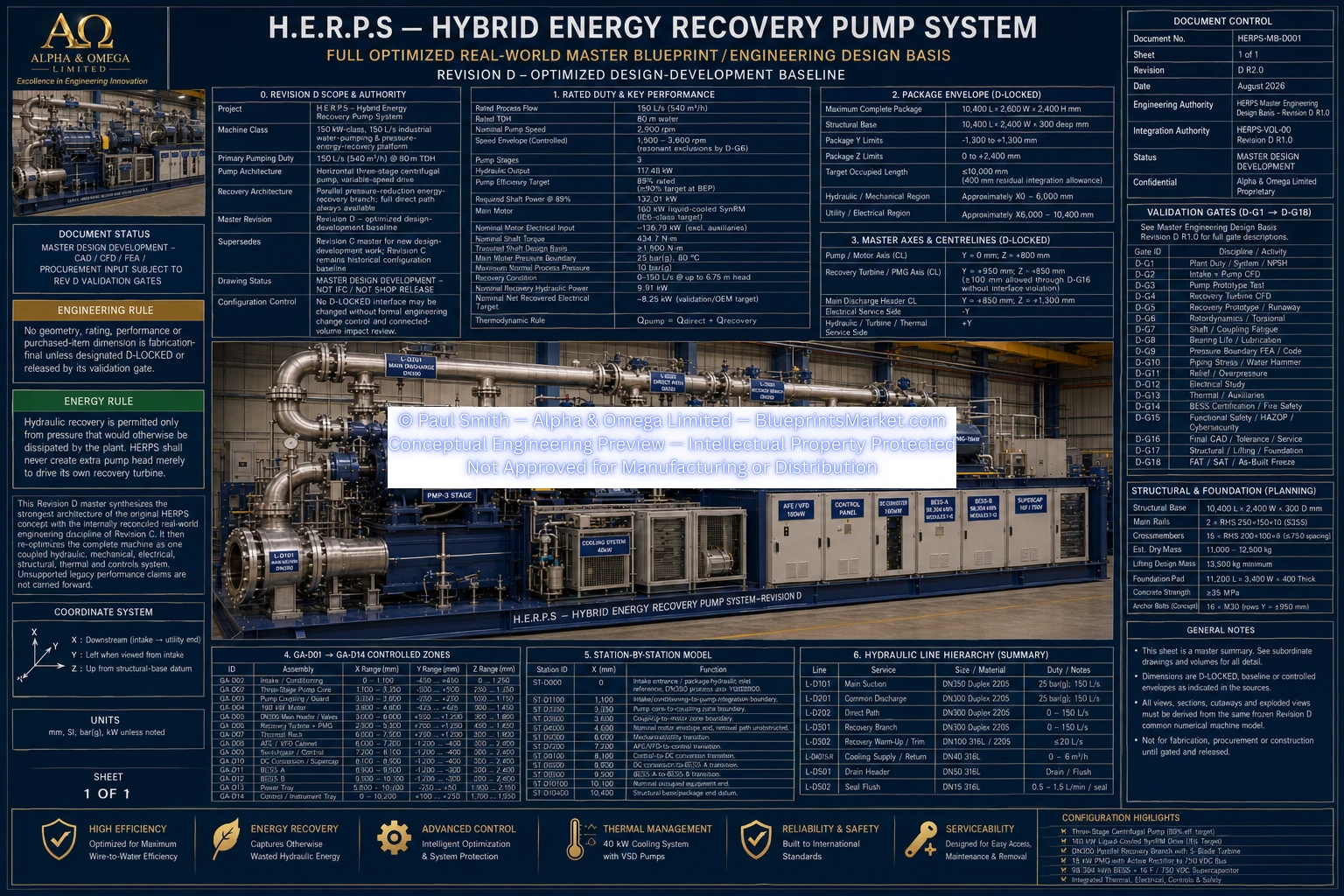
HERPS_MASTER_ENGINEERING_DESIGN_BASIS_REV_D_R2.0.webp
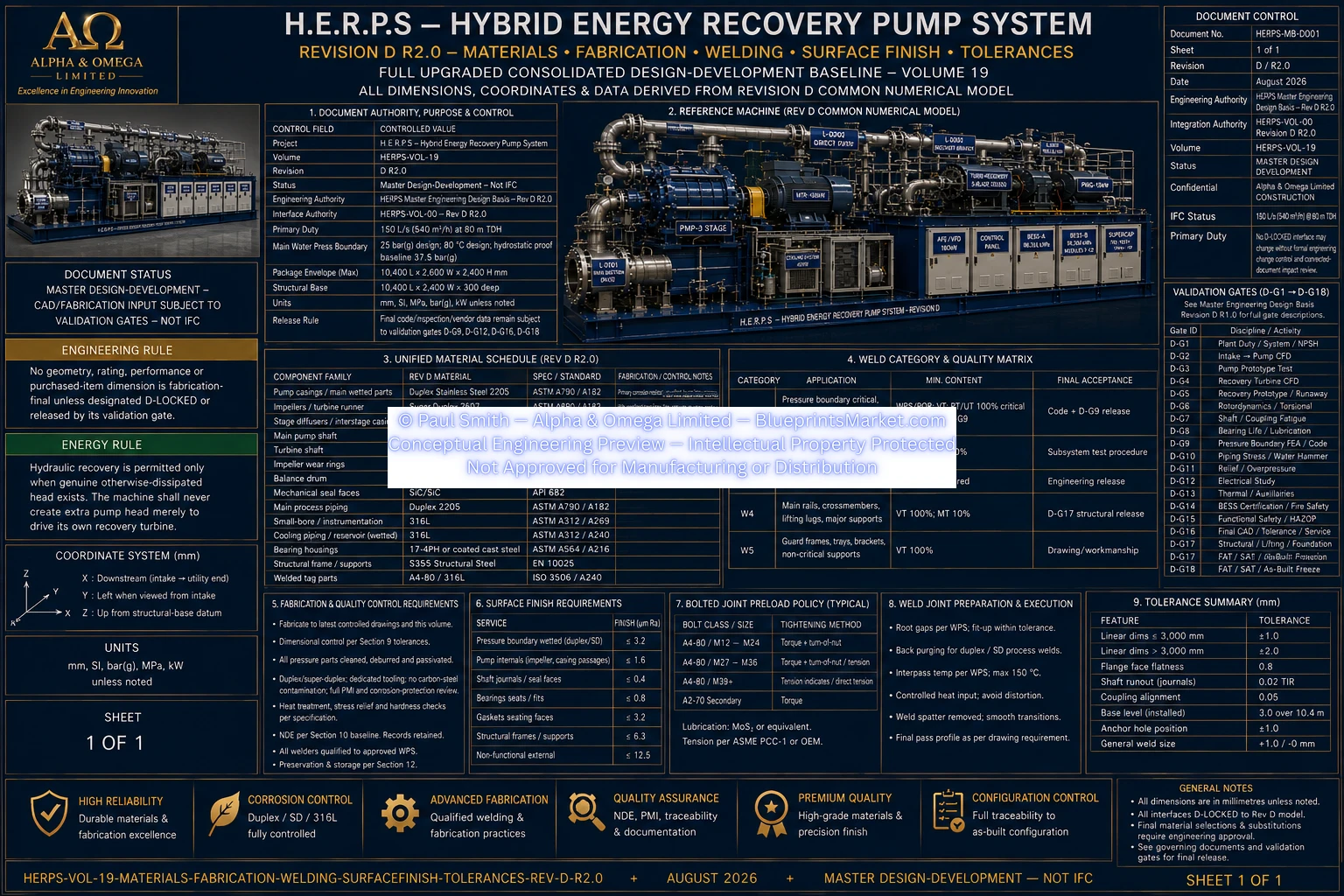
HERPS-VOL-19-MATERIALS-FABRICATION-WELDING-SURFACE-FINISH-TOLERANCES-REV-D-R2.0.webp
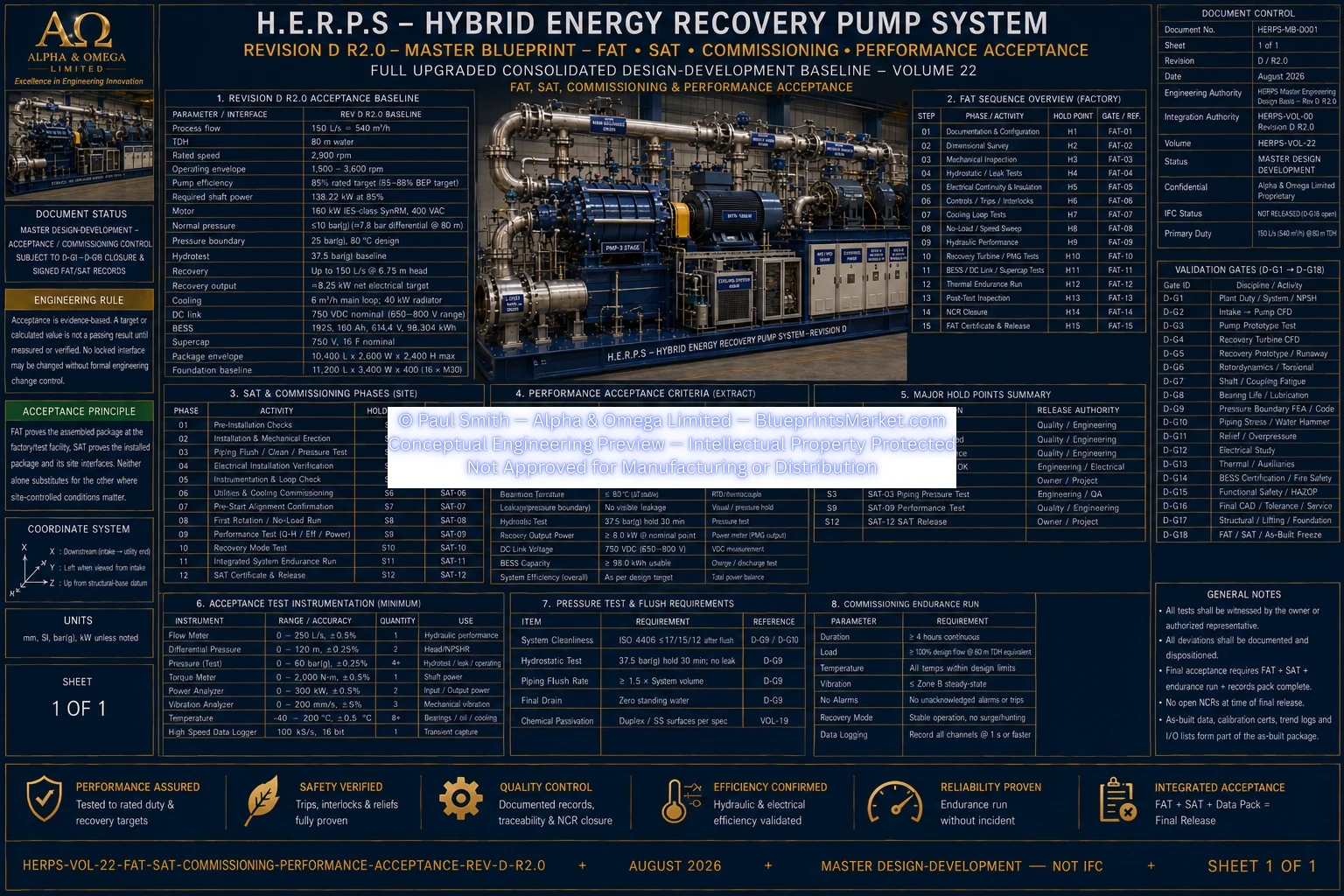
HERPS-VOL-22-FAT-SAT-COMMISSIONING-PERFORMANCE-ACCEPTANCE-REV-D-R2.0.webp