© Paul Smith — Alpha & Omega Limited — PlatformClouds.com — Conceptual Engineering Preview — Not Approved for Manufacturing
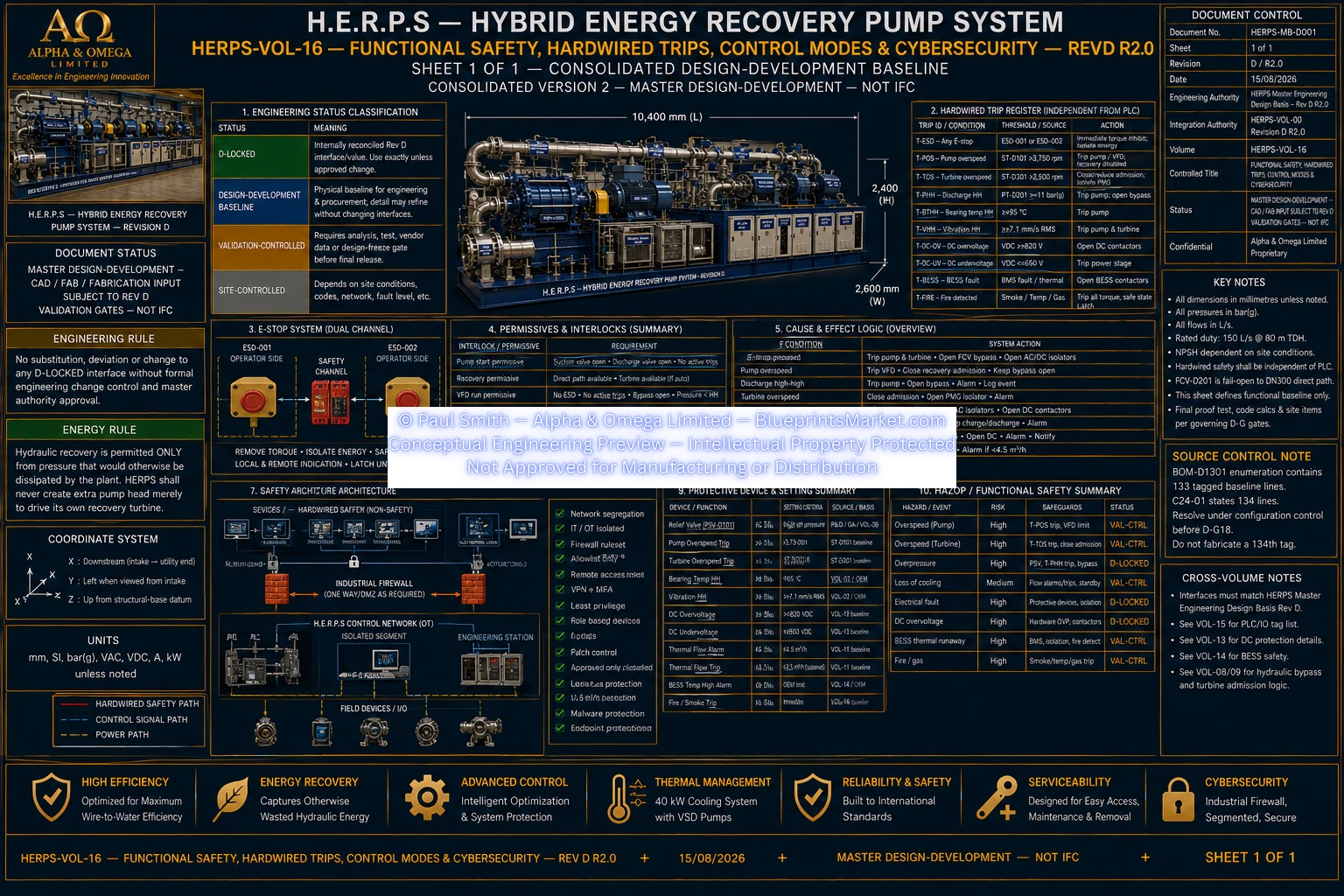
HERPS-VOL-16-FUNCTIONAL-SAFETY-HARDWIRED-TRIPS-CONTROL-MODES-AND-CYBERSECURITY-REV-D-R2.0.webp

Revision D R2.0 — Independent Protection, Safe-State Control & Industrial Cybersecurity
Hybrid Energy Recovery Pump System (H.E.R.P.S)
HERPS Revision D uses an independent functional-safety architecture layered over the normal PLC, HMI, SCADA and supervisory optimization systems.
Safety-critical protective functions are designed so that required protective actions do not rely solely on normal application software, cloud connectivity, enterprise networking or operator intervention.
HERPS separates normal machine control from independent protective functions. Where the risk assessment requires an independent safeguard, that safeguard is not dependent solely on the normal PLC application, SCADA system, remote HMI, cloud service or enterprise network.
Two dual-channel emergency-stop stations — ESD-001 and ESD-002 — are positioned on opposite sides of the HERPS package to provide accessible emergency shutdown capability from normal service approaches.
| Requirement | Revision D Baseline |
|---|---|
| E-stop Stations | ESD-001 and ESD-002 |
| Architecture | Dual-channel monitored emergency-stop loop |
| Reset | Manual deliberate reset after initiating cause is removed |
| Restart | Reset does not automatically restart the machine |
| Primary Action | Remove torque-producing outputs and command the recovery system toward its validated safe condition |
| Hydraulic Response | Safe bypass/direct-path response without introducing an unsafe water-hammer transient |
| Electrical Response | Hazardous electrical energy isolated as required by the validated design |
| Testing | Each channel, reset function and final element verified during FAT and SAT |
| Trip Condition | Revision D Baseline | Protective Response |
|---|---|---|
| Emergency Stop | ESD-001 or ESD-002 operated | Torque inhibit, recovery safe state and validated hazardous-energy isolation |
| Main Pump Overspeed | ST-D101 > 3,750 rpm preliminary baseline | Immediate VFD torque inhibit and recovery disable |
| Recovery Turbine Overspeed | ST-D301 preliminary ≤ 2,500 rpm safety threshold; final value subject to D-G5 | Reduce/close admission, transfer duty to direct path and unload/isolate PMG as required |
| Discharge High-High | PT-D201 ≥ 11 bar(g) preliminary baseline | Controlled pump rundown/trip; recovery disabled; mechanical relief remains independent |
| Bearing Temperature High-High | ≥ 95 °C or lower supplier limit | Controlled pump trip |
| Vibration High-High | ≥ 7.1 mm/s RMS provisional baseline | Controlled protective trip subject to final machine-class validation |
| Cooling Flow Low-Low | < 3.5 m³/h sustained after validated delay | Trip affected heat-producing equipment |
| Coolant Temperature High-High | 55 °C or lower OEM limit | Trip affected heat-producing equipment |
| DC-Link Overvoltage | ≥ 820 VDC preliminary hardware-protection baseline | Hardware protection/clamp/isolation and recovered-power injection inhibit |
| BESS Insulation Fault | BMS/IMD validated threshold | Open BESS contactors and inhibit battery energy transfer |
| BESS Thermal / Off-Gas Event | Supplier and fire-strategy threshold | Isolate BESS, stop charge/discharge and execute approved site response |
HERPS distinguishes the operational high-high pressure trip from the mechanical pressure-relief function. The PT-D201 ≥ 11 bar(g) value is a design-development control-trip baseline and is not the mechanical relief-valve set pressure.
A HERPS start command is accepted only when the required machine, hydraulic, electrical, thermal and safety conditions are satisfied.
| Mode | Primary Function | Safety Authority |
|---|---|---|
| OFF / Isolated | No commanded operation | LOTO and stored-energy controls govern |
| Standby | Pump stopped with required controls and safety functions alive | Trips and alarms remain active |
| Manual Commissioning | Local test and setup commands | Permissives remain active; bypasses controlled and logged |
| Automatic Flow | VFD regulates required flow | Independent trips override normal commands |
| Automatic Pressure | VFD and direct-path controls regulate process pressure | Independent pressure protection remains authoritative |
| Energy Recovery | Recovery train captures available waste hydraulic energy | Direct path assumes duty on recovery fault |
| Minimum Specific Energy | Supervisory optimization minimizes permitted net energy use | Pressure, flow, cavitation, thermal and safety constraints remain hard limits |
| Battery Peak Shaving | BESS supplies configured transient demand | BMS limits override EMS requests |
| Ride-Through | BESS and supercapacitor provide finite-energy DC-link support | Safe rundown/stop occurs if validated energy window is exhausted |
| Emergency Shutdown | Hardwired/safety-rated protective response | Overrides normal PLC/HMI/SCADA, optimizer and remote commands |
The recovery subsystem is not required for basic pumping duty. The DN300 direct pressure-control path provides process continuity whenever the DN300 recovery path is unavailable.
Battery protection is integrated with the wider HERPS cause-and-effect architecture while preserving the ability of the grid-fed pumping system to continue when the BESS is safely isolated, where the applicable hazard assessment permits.
HERPS alarms are intended to be actionable, prioritized and attributable to a defined operator response. First-out trip information is retained to distinguish the initiating event from consequential alarms.
Protective-function bypasses are controlled engineering actions rather than unrestricted operator functions.
Cybersecurity protects the availability and integrity of the HERPS control environment but is not treated as the sole functional-safety layer. The machine remains locally controllable and safely trippable when enterprise or cloud connectivity is removed.
| Zone | Revision D Security Basis |
|---|---|
| Safety / Hardwired Layer | No dependency on enterprise, cloud, MQTT broker or remote HMI for protective action |
| PLC / Control VLAN | PLC, remote I/O and local HMI with only required industrial protocols enabled |
| Drive / Power VLAN | AFE/VFD, converters and approved power-electronics interfaces with restricted access |
| BMS / EMS VLAN | Battery and energy-management communications segregated from general enterprise traffic |
| Supervisory / SCADA Zone | Defined firewall conduits with role-based authentication |
| Enterprise / Cloud Boundary | Industrial firewall with default-deny unsolicited inbound traffic |
| Engineering Access | Authenticated dedicated maintenance path with controlled remote access |
| Logging | Trips, alarms, operator actions, configuration changes and security events retained |
| Final Element | Revision D Baseline |
|---|---|
| FCV-D201 DN300 Direct-Path Control Valve | Fail-open baseline to preserve process flow |
| Recovery Guide / Control Admission | Fail closed-to-minimum-flow baseline |
| Recovery Isolation Valve R-D02 | Final fail state determined by HAZOP without defeating direct-path continuity |
| XV-D201 Discharge Isolation | Fail-last-safe-position baseline unless validation determines otherwise |
| XV-D101 Suction Isolation | Normally open; not used for rapid E-stop closure |
| Cooling 3-Way Valve | Fail position selected to favor equipment cooling without creating hydraulic damage |
| BESS Contactors | Open on hazardous BESS isolation command |
| PMG Disconnect | Isolation coordinated with PMG electrical fault and turbine hydraulic shutdown |
Final functional-safety release is controlled through the D-G15 validation gate. This process determines the final risk-reduction architecture rather than assuming unresolved SIL, PL, proof-test or site-specific requirements.
Revision D requires functional testing of the safety and cybersecurity architecture before the system is frozen as the final production record.
HERPS-VOL-16 is a Revision D R2.0 consolidated design-development baseline. It defines the source-supported functional-safety, hardwired-trip, control-mode and cybersecurity integration architecture while deliberately leaving validation-controlled and site-controlled values to the required engineering gates.
Final SIL/PL determination, proof-test intervals, final trip delays, final valve fail states, protective-device settings, BESS fire response, site addressing, firewall rule objects, hazardous-area requirements and jurisdictional compliance remain subject to the applicable validation, OEM, site and regulatory processes.
This page provides a public technical overview of the HERPS Revision D functional safety, hardwired protection, control-mode and cybersecurity architecture.
The complete documentation forms part of the wider HERPS multi-volume conceptual engineering blueprint system and remains subject to the stated validation gates before IFC, fabrication or production release.
Functional Safety, Hardwired Trips, Control Modes & Cybersecurity forms one integrated engineering volume within the complete H.E.R.P.S Hybrid Energy Recovery Pump System Revision D architecture.
View the Complete HERPS System
Contact Blueprints Market for product, licensing and engineering-package enquiries.
HERPS-VOL-16-FUNCTIONAL-SAFETY-HARDWIRED-TRIPS-CONTROL-MODES-AND-CYBERSECURITY-REV-D-R2.0.webp