© Paul Smith — Alpha & Omega Limited — PlatformClouds.com — Conceptual Engineering Preview — Not Approved for Manufacturing
HERPS-VOL-16-FUNCTIONAL-SAFETY-HARDWIRED-TRIPS-CONTROL-MODES-AND-CYBERSECURITY-REV-D-R2.0.webp

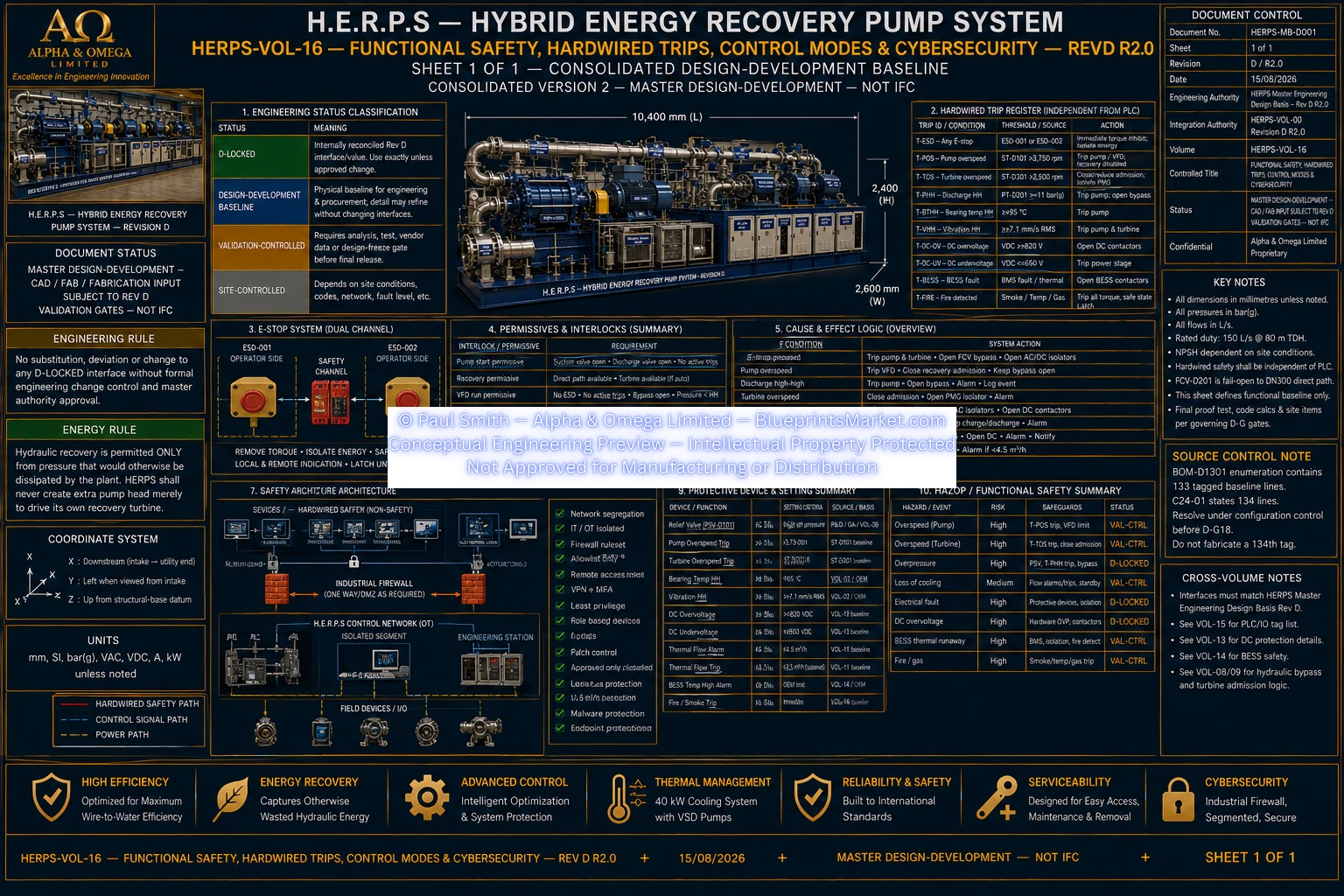
H.E.R.P.S — HYBRID ENERGY RECOVERY PUMP SYSTEM
Functional Safety, Hardwired Trips, Control Modes & Cybersecurity — Revision D R2.0
Revision D R2.0 design-development documentation covering the H.E.R.P.S functional-safety architecture, independent hardwired protective actions, emergency stops, permissives, interlocks, alarm management, fail-state definition, operating and recovery modes, cause-and-effect logic, safe hydraulic bypass, electrical and BESS trip integration, industrial network segregation and cybersecurity.
The H.E.R.P.S control architecture integrates normal PLC/HMI/SCADA control with independent protective functions so that safety-critical actions do not rely solely on normal PLC application logic, SCADA, cloud connectivity, enterprise networking or operator intervention.
The package is designed to retain local control and protective capability when external network connectivity is unavailable. Emergency-stop and independent trip functions are integrated with hydraulic, mechanical, electrical, thermal, recovery-turbine, DC-link and battery-energy-storage protection requirements.
Independent protective actions, emergency-stop architecture, permissives, interlocks, safe-state requirements, trip management, reset logic and functional cause-and-effect integration.
Protective responses for pump and turbine overspeed, discharge high-high pressure, bearing temperature, vibration, cooling faults, DC-link overvoltage, BESS faults and electrical protection events.
OFF/isolated, standby, manual commissioning, automatic flow control, automatic pressure control, energy recovery, battery peak shaving, ride-through and emergency-shutdown operating modes.
Recovery-path control is coordinated with the DN300 direct path so process continuity can be maintained when the energy-recovery branch is unavailable or disabled.
Segregated PLC/control, drive/power, BMS/EMS and supervisory network zones with controlled communication paths between package systems.
Industrial firewall segregation, restricted network access, authenticated engineering access, configuration control, event logging and separation of local machine protection from enterprise/cloud connectivity.
HERPS-VOL-16-FUNCTIONAL-SAFETY-HARDWIRED-TRIPS-CONTROL-MODES-AND-CYBERSECURITY-REV-D-R2.0.webp
Safety-critical protective functions are separated from ordinary supervisory control wherever the required risk reduction demands an independent safeguard. Mechanical pressure relief remains independent of PLC and VFD control, while hydraulic admission reduction and direct-path takeover form part of the recovery-turbine protection strategy.
External enterprise or cloud communications are not required for basic machine protection. The local H.E.R.P.S package remains capable of reaching or maintaining its defined safe state with external network connectivity removed.
The Revision D architecture separates the safety and hardwired layer from external communications and provides dedicated control zones for PLC and remote I/O functions, drives and power electronics, BMS/EMS communications and supervisory SCADA services.
The enterprise and cloud boundary is protected through an industrial firewall architecture with unsolicited inbound traffic denied by default. Remote write access is disabled by default and engineering access is restricted to authenticated maintenance paths under controlled access and change-management procedures.
This material represents the H.E.R.P.S Revision D R2.0 consolidated design-development baseline. Final safety-integrity architecture, proof-test intervals, final protective-device settings, selected valve fail states, BESS fire-response requirements, site network addressing, firewall rule sets and jurisdiction-specific compliance remain subject to the applicable engineering validation, OEM, FAT/SAT and site-controlled release processes.
Conceptual Engineering Preview — Master Design-Development — Not IFC — Not Approved for Manufacturing.